Showing posts sorted by relevance for query Henry the navigator. Sort by date Show all posts

Friday, 13 March 2009

The Age of Exploration ... 'modern' discoveries and developments - part 2/3


Dear Mr Postman .. we've been looking forward to your next positive letter - it will be interesting to hear about the next stage of exploration ..

Henry the Navigator, the Portuguese Prince, was the driver for the exploration down the west coast of Africa and the development of useful tools such as charts to expedite this desire for knowledge during the 15th Century (1400s).

Spain was a little behind with Columbus discovering the New World: America in the late 1400s .. 1492 as the rhyme goes: initially colonization was the main objective, but once gold was discovered trade in earnest began. The continent showed its true colours with the various empires already in place - the Incas, the Aztecs .. these were overrun by the conquistadors and were also devastated by the pandemic diseases brought over from Europe.

The East Indies Spice Islands were explored by the Spanish via the Magellan Straits (south of Chile & north of Tierra del Fuego) .. connecting both the Atlantic and Pacific Oceans. At that time it was not possible to develop that route .. it was far too inhospitable and the innovations required in hull design and rigging had not been thought up.

The French, English and the Dutch were learning from the opportunities provided by the Portuguese and Spanish, together with the new technologies, maps and charts emanating from the Iberian peninsula and were not going to be held back in their thirst for trade, land, conquest, wealth and new possibilties .. it was a fertile time for exploration.

Most parts of the planet had been discovered by the early 1600s, with the Australian east coast finally being mapped early in the 1700s and at that time the Pacific was being more thoroughly explored; the centre of America was reached in the 1500s, but continued to be explored during the 1700s and into the 1800s. The centre of Africa and Australia providing challenges with the tropical diseases prevalent .. were explored during the mid 1800s and into the 1900s; while the seas of Antartica and the Artic had been explored, Antartica and the Artic are still being investigated, albeit the area is known.

Part 3 - the global impact with its economic and cultural influences on the Age of Exploration and Discovery

Thank you Mr Postman - that was a most informative 2nd part - til tomorrow ..

Friday, 28 November 2014

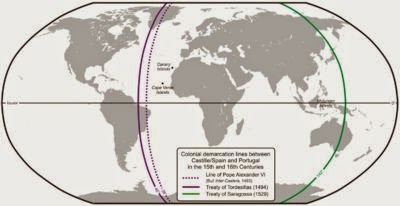
Food with Thought: No 2 … Brazil … and how the world was divided into two by Papal Treaty in 1494 …


This is my second Food with Thought themed lunch to highlight an area of the world … and as is my wont give a little extra detail i.e. history …

Brazil and our Apperitif fizz

  • Navigation – and the colonisation of Brazil

  • The Borgia Pope

  • How and why South, middle and North America are mainly Spanish speaking


It was with the advances of navigation and a greater understanding of the seas, that the Portuguese became the great explorers of the 1400s …


Lines dividing the non-Christian
world between Castile (modern
Spain) and  Portugal.  The 1494
Tordesillas meridien (purple)
and the 1529  Zaragosa
antimeridien (green)
… sailing down the west side of Africa, round the Cape of Good Hope and on to India … thus bypassing the controlling Turks of the Ottoman Empire in the Middle East.


Henry the Navigator, (1394 – 1460), the Portuguese Prince, initiated the exploration down the west coast of Africa and the development of useful tools, such as charts to expedite this desire for knowledge during the 15th Century (1400s).


Tordesillas Treaty
The Spanish from 1492 went west and found land in the Caribbean Islands, before setting foot on the North American continent … Brazil was found at much the same time in 1500 but by Pedro Alvares Cabral …


Surprisingly to me anyway! … a Papal Treaty (Treaty of Tordesillas) of 1494 had already divided the world into two … the Spanish Pope, Alexander VI, (1431 – 1503) instigated this bull …


… the purpose was to divide trading and colonizing rights for all newly discovered lands in the world between Portugal and Spain to the exclusion of other European nations.


The attractive charismatic Pope:
Alexander VI ... 
The Portuguese being given control over Africa, Asia and the Eastern part of Brazil, while the Spanish received everything west of that line … only later realising their good fortune …


This is complicated and involves the Borgia Pope mentioned above … he is one of the most controversial of the Renaissance popes, because he broke the priestly vow of celibacy and had several legitimately acknowledged children.


Therefore his italianized Valencian surname, Borgia, became a byword for libertinism and nepotism …


Anyway – enough of history … shall we eat?  Come share with me an aperitif to set us on our way to that lunch table …


Our sparkling aperitif was “Coco Nova Brut” – a blend from the hot area north-east of Rio: the Sao Francisco Valley.  A drier style made from blending Sauvignon Blanc, Chenin and Verdejo grapes – the Verdejo are generally harvested at night – when less oxidation is likely to occur.


Cue in the clues:  This dry sparkling wine fizzes with fresh melon juice, white nectarine flavours, hints of almond, giving an aromatic, often soft, but richer texture of taste.


Salmon and Sea Bass Ceviche
F o o d … we needed food!  This time as our starters we had Salmon and Sea Bass Ceviche with seasoned leaves, decorated with delicate avocado pieces and pickled vegetables … this was positively delicious!


Now I need to go to the left-hand side of the menu to check out the wine … an un-oaked 50:50 blend of Chenin Blanc and Viognier … a good acidity: excellent to serve with fish.


Cue in the clues: This light in colour, with a greenish tinge, wine – had a hint of white flowers on the nose, fresh aromas too of pears and pineapples … soft and supple in the mouth … ‘twas good and tasty!


Where do they get these descriptions?!


Our main course was ‘Chimichurri Chicken en Croute’ – adapted to our English palates … the chicken was served en croute … while we had a choice of a lighter, simpler chicken sauce or the Chimichurri – that’s what I had!


Chimchurri sauce
Chimichurri, originally from Argentina, is a green sauce used for grilled meat … it is based on finely-chopped parsley, minced garlic, olive oil, oregano and red or white wine vinegar.  This is my style of sauce …


To go with the main course we had a blend from …


Brazil shown within
South America


Cue in the clues:  ruby dark grapes with a hint of white pepper … which should (?) leave us with a clean aftertaste … I cannot remember that part … but …


Rio Sol Cabernet Sauvignon Shiraz … comes from the Sertão … the semi-arid region in Northeastern Brazil … a Brazilian historian once referred to colonial life in Brazil as a “civilisation of crabs”, as most settlers clung to the shoreline …  


The Sertao ... the semi-arid
north-east 
The director of the Portuguese wine company Dao Sul just adds to this picture … as he advises his workers to “watch out for alligators” as they sometimes come up from the river and nip the workers’ ankles as they harvest the grapes.  


As introductions go, this advice is a little unusual, even by the standards of eccentric vineyard owners.


Thinking about this I need another drink before I enjoy the dessert!


A Rosé – to go with the dessert – but this has a very descriptive hue … Rio Sol Touriga Nacional Shiraz Rosé evokes an intense fruity flavour …


Cue in more clues: predominantly cherry, strawberry, blueberry and raspberry … giving us a playful after-taste to enjoy our German-Brazilian dessert.


Pudding!  Torta Alemã is a Brazilian dessert, though its name in Portuguese means “German Pie”.  Many Germans settled in Brazil … so various recipes became absorbed into Brazilian food lore.


This was particularly delicious … the chocolate “ganache” in this pie is called brigadeiro de colher, and is a spreadable version of the very popular Brazilian chocolate fudge truffles called ‘brigadiero’ …


Brigaderios
We had Columbian blend filter coffee and brigaderios to follow … I might say we had one older chap on our table who ate all of these – without offering them round … he was remarkably selfish and his conversation was all about himself!!  We were polite and I knew one other lady on the table … so we laughed a lot …


Linda fortunately knew the wine merchant’s representative – her daughters had gone to school and socialised with him and other friends …


Representation of the landing by
Petro Cabal in 1500
… he was the worse for wear, poor chap, as his wife had recently had a difficult birth … but all was well with their daughter … he looked somewhat drained!  But I think was grateful he was sharing the table with us … and ‘felt at home’ with Linda around … and not a load of fuddy duddies!!

Gathered grapes in Brazil

We had this lunch on 21st October and I see I noted that our weather was much the same as in Brazil 19 deg C (66 deg F): cloudy with rain!


I hope you all had a lovely Thanksgiving, questionable Black Friday … and I’m sparing a thought for Denise in Brisbane after the major vortex storm that ripped their coastline apart on Thanksgiving Day …

Oh by the way .. this was held at the same seafront hotel as the South African lunch ... 

And out of interest our temperature is still so warm ... yesterday the day of posting we had 13.8 deg C - which is 55.84 deg F .. today it's slightly warmer ... 


Hilary Melton-Butcher
Positive Letters Inspirational Stories

Tuesday, 28 April 2009

This is a story for Catarina ...Have some Madeira m'Dear?


Dear Mr Postman .. how lovely to see you today .. and I see you've brought a letter for Catarina .. this should be interesting ...

Dear Catarina - my mother loves seeing you when you visit your great-grandmother, Olinda, who is also in the hospital .. and it is really kind of you to wave back! I thought a little story about your homeland (except you're so English now) and some other little points of interest that I've found out or remembered ... Mum and I call these - Hilary's snippets! .. might interest you.

Dear Readers - Catarina is 9 .. and loves school .. and loves animals - she has a cross Labrador-Alsation and cat here in England, while they also have two dogs and some kittens in Maderia - where the family have a home. She was reading a story about a cat .. (bad Hilary cannot remember the name of the book!) .. I wonder if she's read the story of the Mousehole "Mowzal" Cat I mentioned recently? ... I'll print her a copy out. Her grandmother, Maria, takes care of her after school .. and they visit and bring great-grandmother some treats - to ensure she gets better soon.

Madeira .. conjured up memories from our past .. my own grandmother had visited Madeira quite often on her way out to India from the 1920s onwards .. as it was the scenic route .. via Cape Town and the tip of southern Africa. So we remembered the embroidery, the magnificient scenery of this tiny island ..the fantastic flowers, the butterflies .. apparently the biggest European tarantula spiders live on the Desertas islands - and can be as wide as a normal man's hand .. while the islands have more than 250 species of land molluscs (snails and slugs), some with very unusual shell shapes and colours - they are only found here and are also in need of protection.

My mother loves butterflies and we have them flying around her room .. painted lady, swallowtail, large skipper, male orange tip, small copper, common blue .. such wonderful evocative names .. Catarina - you can almost visualise them from their descriptions - can't you? Your Madeiran Large White butterfly is extremely rare .. and needs protection too - have you ever seen one?

We talked about Madeira .. and did not know much .. so my mother suggested that I 'google' it .. and see what I came up with .. Madeira was discovered by the Portuguese in their exploratory phase in the 1400s .. finally it became independent on 1 July 1976. The population of Eastbourne where we live is 95,000, while the county of East Sussex has a population of about 762,000 .. Madeira falls somewhere in between with a population of 246,000.

Funchal is the capital and is named after the funcho (fennel) growing there. For us .. both areas have important tourist industries .. Eastbourne claims to be the sunniest place in Great Britain .. it is pretty good!! .. while Madeira basking in the Atlantic Ocean south of Portugal and off Morocco can definitely claim to have a sunny climate.

However ... Madeira has one claim to fame that we here in Eastbourne do not have .. though my mother's favourite 'wish' tipple now is champagne, which they're starting to being able to produce in the UK due to global warming ... I deviate .. Madeira wine .. that wonderful fortified Portuguese wine .. have you tasted it - Catarina?

The islands have a long winemaking history dating back to the Age of Exploration when Madeira was a standard port of call for ships heading to the East Indies or the New World. Once when a shipment was returned after a voyage being tossed on the high seas, exposed to excessive heat and changes of temperature .. it was found that the wine flavour was transformed. A similar process is utilised today .. however the wine "vinho da roda" does not now make a round trip in a ship!! .. and Madeira has become a very robust wine that can be quite long lived, even after being opened.

Madeiras have been known to survive 150 years in excellent condition .. and it is not uncommon to see Madeiras pushing the century mark for sale at stores that specialise in rare wine!! Before refrigeration Madeira wine was prized in areas where it was impractical to construct wine cellars, e.g. in the southern States of America, because unlike other fine wines it could survive being stored over hot summers without deteriorating.

Some other interesting notes for our American readers .. apparently the American leaders - founding fathers and presidents - all appreciated the Madeiran wine. Thomas Jefferson insisted on it being used to toast the Declaration of Independence - 4 July 1776. As well as the "vinho da roda" wine, there is another style called "Rainwater" - it is rarely produced today and, when it is, is usually shipped only to the the US. A possibility for the name 'rainwater' is that rain somehow got into the casks while sitting at the docks .. so the merchants decided to offer this 'new' wine .. and were surprised to find that it was very popular with the local Americans!!

My mother and I remember the name 'Madeira' for another reason .. the wonderful song from Flanders and Swann "Have some Madeira m'dear!". It's available on Youtube .. they were wonderful songs with some brilliant lyrics .. so do please have a listen .. Youtube - Flanders and Swann - Michael Flanders is in a wheel chair, while Swann plays the piano: an inspiration .. bringing joy to my mother some 50+ years later ... we did used to laugh and still do .. they are just so light and touching .. stories told through lyrics and music ..
http://www.youtube.com/results?search_type=&search_query=Madeira+M%27Dear

Have some Madeira M'Dear .. is a naughty but fun song - loved by all ages .. with its lyrics ..
and starts:

She was young, she was pure, she was new, she was nice,
She was fair, she was sweet seventeen,
He was old, he was vile, and no stranger to vice,
He was base, he was bad, he was mean.

It's been a pleasure to meet you Catarina with your family, and my Mum and I both wish you all the best at school and for happy times here in England and in Madeira .... lucky girl .. can you pack us in your suitcase please .. so we can come with you??!!

Thank you Mr Postman .. it's kind of you to say that you enjoyed Catarina's story .. and that she'll be happy to know about the Mowzal cat! .. she's a lovely girl - well mannered and very polite = a pleasure to have around!!
PS: Henry the Navigator, a Portuguese Prince, was instrumental in the Ages of Exploration .. parts 1, 2 and 3 ...

Hilary Melton-Butcher
Positive Letters

Monday, 24 April 2017

T is for Turkey …


T for This Time … you get the history – the T for Turkeys in the UK and USA are much the same … so not a lot of British information available for me to post up …

Slate Turkey


Turkeys have been around for millennia (originating in Mexico/ Americas) … but were brought to Britain in the 1520s (via Spain) by Yorkshireman William Strickland, a navigator, who sailed on early voyages of exploration to the Americas …


The Lectern in St Andrew's Church
showing the turkey carving and
Coat of Arms below


… on his return to Bristol he sold the birds and is credited with their introduction into Britain … being granted a Coat of Arms … the bird motif is incorporated into it. 


c/o Britain Express photo
While in St Andrew’s Church, Boynton, East Yorkshire the lectern has been beautifully carved in the shape of a turkey …


The Poultry Club of Great Britain - link below - we have the nominate race here - the bronze with white in its tail ... was the breed introduced to us ... 


A Norfolk Bronze
The birds had been identified as a type of guineafowl … and in those early days were called “turkey fowl” before being shortened to just “turkey”…


... this was because there were 'Turkey Merchants' bringing in a range of goods from the Middle East to be traded ... thus 'turkey' was appropriated for the bird ...


Henry VIII was the first English king to enjoy turkey, although Edward VII made eating turkey fashionable at Christmas … it replaced peacocks on the table in Royal Courts.


Bourbon Red Turkey

By 1720 … turkeys were walking from Norfolk to the London markets in small flocks of 300 – 1,000.  They started in August and fed on stubble fields and feeding stations along the drove … as with geese their feet were dipped in tar …


Narragansett Turkey Hens


There are 43 breeds of turkey in the UK … but many of them are very similar to their American cousins … so the best place to look is the RBST site for Turkeys under the Poultry section … 


That is T for Turkey Treats and Treasures of the Thanksgiving Table and the Christmas Table … from Aspects of British County Rare Breeds …


Counties with the letter T …
(note some Counties have been retired!, or amended over historical local government … but some I’ve included)
England: Tyne and Wear
Northern Ireland: Tyrone
Scotland:  None
Wales:  None


Turkey History and Other Facts ...  c/o British Turkey Co


Poultry Club of Great Britain - history of Turkeys


Hilary Melton-Butcher
Positive Letters Inspirational Stories