
It is Library Lover’s Month reminding us that books became one of the most efficient and enduring information technologies every invented – libraries paved the way for scholars to travel the known world ...
... the Royal Library of Alexandria was the first, largest and most significant library in Western civilisation functioning as a major centre of scholarship in Greek and Roman times.
Above:
Ptolemy 1 ensured its construction in the 3rd century BC, and those early Rulers kept it in order fostering the development of its museum, while carefully maintaining the distinction of its population’s three largest ethnicities: Greek, Jewish and Egyptian.

Julius Caesar in 48 BC ‘accidentally’ burned down the library in his Siege of Alexandria – before he turned his conquering eyes towards northern Europe.
Strabo, a Greek historian, geographer and philosopher, recorded that scholars were then able to use an off-shoot of the Great Library in the western Greek quarter of Alexandria. Strabo personifies travel and learning two thousand years ago ...
 |
This Latin inscription regarding Tiberius Claudius Balbius of Rome (died c AD79) mentions the “ALEXANDRINA BYBLIOTHECE” (line eight). |
His life was characterized by extensive travels – he was born in northern Turkey – journeyed to Egypt, down the Nile as far as present day Ethiopia, eastwards into Asia Minor, exploring the Mediterranean coasts, and as far south as Mauritania, in northern Africa.
Sadly his first major work has been lost – “Historical Sketches” – but his 17 volume “Geographica” presented a descriptive history of people and places from different regions of the world known to his era ... copies of which remain to this day, can be studied and have been used extensively in the intervening years.
In 365 AD Crete experienced a huge earthquake causing a massive tsunami – the effects of which we now have a greater understanding – then swept across the southern and eastern Mediterranean causing widespread devastation particularly to Libya, Alexandria and the Nile Delta. The great Library has been underwater ever since ...
 |
| Inside Bibliotheca Alexandrina |
... however a phoenix has arisen ... the Bibliotheca Alexandrina ... a commemoration of the Great Library and an attempt to rekindle something of the brilliance that this earlier centre of study and erudition represented. The old library was tri-lingual, so will the new Bibliotheca be – containing works in Arabic, French and English.
This new library at Alexandria has shelf space for eight million books as well as all the mod cons – a conference centre, specialised libraries for maps, multimedia, the blind and visually impaired, young people and for children; there are four museums, four art galleries for temporary exhibitions, fifteen permanent exhibitions, a planetarium and a manuscript restoration laboratory.
 |
| A room full of scrolls |
The first known library of its kind entrusted to gather a serious collection of books from beyond its country’s borders, the Great Library at Alexandria over two thousand years ago was charged with collecting all the world’s knowledge.
This was done with a royal mandate involving trips to the book fairs of Rhodes and Athens, and included a policy to take the scrolls and books off every ship that came into port. The original texts were kept, copies were made and sent back to their owners.
Alexandria, on the island of Pharos within the Nile Delta, soon found itself the international hub for trades, as well as the leading producer of papyrus and, soon enough, books.
 |
| Poseidon at the Bibliotheca Alexandrina |
The Library was built in the style of Aristotle’s Lyceum, adjacent to and in service of the Musaeum (a Greek Temple or “House of Muses”, hence the term “museum”).
The layout is not known, but comprised a Peripatos walk – after Aristotle’s method of teaching philosophy as he strolled around – gardens, dining area, reading room, lecture halls and meeting rooms – the influence of that early model can be seen in the layout of university campuses.

The Great Library had an acquisitions department probably nearer the harbour, a cataloguing department; there was a hall containing shelves for the collections of papyrus scrolls, known as bibliotheki. Legend has it that carved into the walls above the shelves was an inscription that read: The place of the cure of the soul.
The collections of books has always changed with the times including clay tablets, papyrus scrolls, parchment quartos, books, pamphlets, newspapers, journals, magazines, comics et al ...
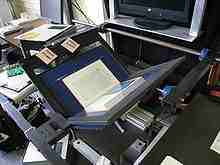 |
| Book Scanner at the Internet Archives |
... today that continues with the ‘Internet Archive’ – whose stated mission of “universal access to all knowledge” really is not any different to that conferred up the Great Library over 2,000 years ago.
The Bibliotheca Alexandrina contains this mirror collection of the original Californian ‘Internet Archive’ including collections of digitized materials: websites, music, moving images and nearly three million public domain books.
There is a new library being built in Birmingham, England ... which has as its slogan “Rewriting the Book” ... and they are selecting 26 ‘local’ people who have been influenced in their use and continuing use of the library to improve and enhance their knowledge.
 |
| An artist's impression of the new library |
Eighteen people have been chosen so far ... the ‘Faces’ including a salsa-dancing linguist, a new media entrepreneur, a veteran of community work ...
... you can visit the Birmingham Library website and see the diverse range of peoples and ideas, including YouTube clips, – who offer hope through their endeavours and ...
... perhaps reflect that the British Empire might have waned – but in the meantime we have garnered a magnificent diaspora of life who have made and are making effective use of libraries, and who now are giving their input on the design for the new library due to open in 2013.
 |
| From a cultural centre attached to the Bibliotheca Alexandrina - CULTNAT "He Who Loses His Past is Lost" |
You will find Ellise Miles there – an avid reader – who will only be 13 when the Library opens its doors in 2013 ... what a great place to find herself in – influencing our resources for future generations.
It is difficult to imagine how some of the great turning points in western history could have been achieved without the book: the Renaissance, the Reformation, the Scientific Revolution and the Age of Enlightenment all relied on the printed word for their spread and permanent influence.
For two and a half millennia, humanity used the book, in its manuscript or printed form, to record, to administer, to worship and to educate.
 |
Bronze sculpture, Bill Woodrow’s ‘Sitting on History’ at the British Library. Sitting on History, with its ball and chain, refers to the book as the captor of information which we cannot escape. |
Yes, there are many other libraries or centres of learning, which we need to encourage others to benefit from the care and information on hand within these centres – a great example is Iain McColl – one of ‘the Faces’, who was homeless and living in a hostel ... he now has a home of his own and is continuing his studies in the construction industry – see his story here.
So in this month for Library Lovers as we celebrate our future perhaps we should remember in our hearts as we write our books, or sit with them those words from long ago:
Within books we will find the place to cure our soul.
Julie Flanders librarian – What Else is Possible
A cultural centre associated (CULTNAT)with the Bibliotheca Alexandrina;
El-Sennary House Festival article: - Ahram Online Folk
The Library at Birmingham - with short biographies on 'the Faces' - Helping to Rewrite the Book
Hilary Melton-Butcher
Positive Letters Inspirational Stories






.jpg)