Monday, 21 May 2012

Uppingham-by-the-Sea ... the narrative draws to a conclusion ...


In the year 1877 ... when boys were still alive ...

... before that though the 1876 calendar had to write itself to a close into this little narrative, so onward we go ....
Ford Maddox Brown's Navvy (USA)
depicted "The Work" 1865

Ø September 15th and 16th dawned – the school returned filling old quarters and several additional houses.


The medical officer and the ready pickaxe of “Sanitary Tom” (as the boys called the navvy who was his stout ally), had been at work on sanitation arrangements.


(At Uppingham the same work started on September 14th – the sanitation had finally been called out as the fever’s incubator).


Ø The term opened smilingly .... just five weeks later – a case of scarlet fever occurred, followed by half-a-dozen more, ... their prosperity staggered under the ‘what next’ syndrome ...

-         Would it spread to the village, across the school - could they stay - and many other challenging thoughts ... and what of other infections?

-         They had good scientific advice on the spot, from the medical officer – who was advised out of Oxford, so no time was lost in stamping out the plague ... by ... page 28 describes the plan:

-         War is not made with rose-water, and fever germs can be exterminated, it seems, by nothing less exasperatingly unsavoury than carbolic acid, an agency which was laid on without any ruth.

"A Girl with a Watering Can" -
Pierre-August Renoir 1876

Grumblers were offered the alternative of being smoked with sulphur.  Some complained of sore throats, contracted, they said, from the fumes of the disinfectant, and declared that the remedy, like the vaccination, was only a mitigated form of the disorder.


The landlords of our studies looked on with irresolute wonder, when some of us sprinkled their floors with a potent decoction poured from watering-pots.


Most of them regarded it as a kind of magical rite into which it would not be seemly to inquire.

Probably the best disinfectant applied was the clear strong wind, which ten days after the first case succeeded the previous relaxing weather.
Pebbly Beach at Eastbourne

All windows and doors were ordered wide open for the free passage of the blast; and the boys were directed to bring down their rugs, great-coats, and dressing-gowns, and anything of the kind which might be supposed to harbour mischief, and spread them for purification on the pebbles of the beach.


It was thought the germ was probably caught in the railway – so excursions were discontinued for a time.

Worse would have occurred had not the villagers been ready to assist with the isolation and other necessary matters to curtail this outbreak.


Page 29 discusses the possibility of bullying due to confinement in the winter months ... however the advantage of self-governance prevailed ... old rules had to be relaxed – in general the result was all went well; of course wrong things were done at Borth as elsewhere, but their insignificance for the most part would provoke a smile.


As the term progressed, November set in with its early dark evenings – the school curriculum was rearranged – afternoon school began at sunset, the Debating and other societies met on half-holiday evenings, so the dark hours did not hang heavily, and the expected tedium of an Arctic winter was not experienced.
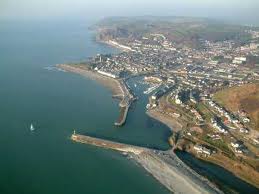
Aberystwyth
The term closed with a concert given in the Assembly Room at Aberystwith, repeated the next night in the Temperance Hall at popular prices.


The Old Boys returned to play the customary football match against the present school ... and were beaten 2-1; prizes, class-lists, and the Headmaster’s speech closed the day.


No mention was made for their return to Middle England or to the coast of Wales in the year 1877.

“Sit down, and hear the last of our sea-sorrow”
                             from “The Tempest”

Ø 22nd December, after inspection ... and in the face of Dr Acland’s (an Oxford consultant) report, the Trustees “deeply regret they cannot at present recall the school to Uppingham.”  So they went back to the sea.


The boys with sticks in 1876, were watched by boys named Bevan, in the year 1877 ...   ("ab-Evan" meaning son of Evan - Welsh origin)

The school returned in January ... for what would become the Farewell Term ...

Fewer masters’ families had remained ‘in camp’ ... some had gone to winter quarters at Aberystwith; some had already resettled at Uppingham.


A not so niggardly vegetable plot
Connection with home began to be retightened also by parochial and other common transactions, in which we took our share from a distance ...


... the deserted gardens at Uppingham did not waste their sweetness on the air ... a thin intermittent stream of their products found its way along the nine hours of railway through most of the year: flowers, fruit and vegetables ... were welcome by all, including dwellers in this somewhat austere tract where they did not grow or grew very niggardly.


Further details of “contraband” drew the attention of the London and North-Western Railway Company, whose officials called to account one of our servants for travelling with an excess of personal luggage ... the artless contrabandist, besides his own modest pack, had fourteen several hampers and boxes under his charge!  This was checked.


But there was a Post Office miscreant, who systematically staved in and pounded into such odd shapes the little tin boxes in which our rose-fanciers had their choice blooms sent them by post?  The Post Office disacknowledged, the school remonstrated – the criminal was stopped.


Business matters from home needed to be dealt with ... as parishioners and ratepayers.  Someone who, even bought a freehold of land, had clearly not despaired of their Rutlandshire.


This term’s life, with exceptions, continued much as before ... the round of work and play was much the same; the harriers were out again, football went on as before, till superseded by the “athletics,” ...

Ø On 7th March an athletics match against Shrewsbury School on their ground was held ... a battle drawn.


The difficulties encountered this term were the elements...


Harpies
First off two new boys rambled forth and were missing by tea-time .. search parties were organised north and south ... they were found perched upon a rock up the cliff to escape the rising tide telling stories – unaware in the darkness the tide had ebbed, or to minimise their fears by staying put, thankfully blessed with a mild January night.


This was the sportive prelude of more serious troubles ...

Ø Monday 29th January – a servant was conveying the dinner of his master’s family from the hotel kitchen to Cambrian Terrace.

As he crossed the gusty street between them, the harpies of the storm swept the dinner from the dish, and rolled a prime joint over and over in the dust; a leg of mutton was following, but he caught it dexterously by the knuckle-end as it fell, and rescued so much from the wreck.

Borth - the storm did blow
Did the wind not blow?  For three days the sou’-wester had been heaping up the sea-water against the shores of Cardigan Bay.


People remembered with misgivings that an expected high tide coincided in time with the gale, and shook their heads significantly as they went to bed on that eve.

A storm wave is part of a system of aggression which the sea carries upon these coasts ...

Ø 30th January’s half light gloomed eerily ... the classes emerging from morning prayers, found the street between them and the Terrace threaded by a stream of salt water, which was pouring over the sea-wall ...

Before morning school was over the stream had become a river ...

... those who were well placed saw a memorable sight that morn, as the terrible white rollers came remorselessly in, sheeting the black cliff sides in the distance with columns of spouted foam ...

... then thundering on the low-sea wall, licking up or battening down the stakes of the palisades, and scattering apart and volleying before it the pebbles built in between them, the village street was heaped with the ruins of the barrier over which the waters swept victoriously into the level plain beyond:

          The feet had hardly time to flee
    Before it brake against the knee,
    And all the world was in the sea.

          Those who were looking inland saw how ...

             Along the river’s bed
         A mighty eygre reared its head
         And up the Lery raging sped.

          ... at Borth they escaped lightly, at Ynyslas the tenants fled to their
          upper storey as the tidal race plunged them into twelve feet of
          water;

          ... how it breached the railway beyond, sapping four miles of
          embankment, and sweeping the bodies of a drowned flock of sheep
          far inland to the very foot of the hills;

          Yet they saw enough to make them recall the grim memories of
          Taleisen’s shore ... and wonder if circumstance would be added to
          the legend of the Lost Lowland Hundred.

Pages 33 and 34 describe the ensuing horrors and reparations made by gangs of boys with masters leading, looking like scurrying ants ...

... their rudimentary defences were fortunately not tested, as the wind veered, allowing the water of the bay to return to a degree of normality.

"The Bed" Toulouse Lautrec 1893 -
looks too comfortable for me!
For their exertions they rewarded themselves with a lie-a-bed the next morning in place of early school!

Borth was not too bad, Ynyslas suffered severely, the surrounding countryside too – the school could and did help with a subscription to replace the cottagers’ losses.

They also put their backs into helping with the clear-up – for what had started out as “something not altogether unpleasing to us in the calamaties of our neighbours,” but the “humorous ruth” with which we contemplated the comical incidents of the disaster was exchanged in good time for practical pity.

Railway crossing the Dovey
It was a fortnight before the next train ran, but in the meantime the service was bridged by coach and horses.

There was another privation! – you would only know the football field at Ynyslas was there – from the goal posts rising mournfully through the floods, were a landmark which the boys recognised with rueful eyes in the midst of the drowned and deformed landscape.


Within three weeks the elements caused us alarm.  A heavy gale got up in the evening of February 19th, and roared all night upon the roof of the hotel, tearing up the fluttering tiles in patches, and sending them adrift through the air ...

... yet it was dry ... exceeding cold – but the schoolboy is hungry at all times; what must he be at night when dragged from bed to save his life, and forced to sit up, rather chilled and very empty, for several hours before daybreak?


... the Headmaster appeared with “a Midnight Feast” .. at least biscuits, and what supplies could be requisitioned at the moment, to provision the watch.
Thereafter the weeks rolled smoothly on, unmarked by moving incident, till they gladdened us with the growing light of spring, and brought us within near sight of our home.


Must the truth be told?  We are all of us loyal sons of Uppingham, but not all of us were glad to find our return to the mother-country was at last arriving.

However, alike for those who were impatient and those who were reluctant to attain it, the equal-handed hours brought the end of our exile.

Title page of the first quarto, 1600
On one of last evenings, April 6th, a reading was given in the school-room, “A Midsummer Night’s Dream” with Mendelssohn’s music; no unfit close, we said, to our annus mirabilis.


For, indeed, its incidents had been “such stuff as dreams are made of,” as whimsical if not quite harmless, as if their plot had been directed by the blithe goblin of Shakespeare’s fantasy.


The encore of a second recital was offered to the good people of Borth ... they enjoyed it hugely.


But a more solemn farewell was taken on the morrow full details on page 37, but the whole village came down to the school doors, with banners, choirs singing ... when the cheers for “Uppingham” and our answering cheers for “Borth” had rung out across the sands to seaward ....

... the valediction was heard thus ...:

“We, the inhabitants of Borth, beg to tender our most sincere thanks to Dr Thring, and all the masters and scholars of the celebrated Uppingham School, for the very many generous acts, and kindly feeling exhibited to us during their sojourn here.”


... it was added ... he commented on the discipline which (from the evidence of their conduct when at large) seemed to rule the school; naively but pointed he noted that ...

ü No offence had ever been given;
ü No boy had laughed at the villagers, if they were old and queer-looking or queerly dressed;
ü There had been no disorder, no shabby act, nothing “un-decent” (so he put it in his unpractised English) during the whole twelve months we had spent among them.”

Welsh cottage

Clearly, as on that evening, we shall always see, distinct in the quiet light of the afterglow, the ranks of serious faces, touched and stilled by the surprise of a contagious sympathy, as English boys and Welsh cottagers looked each other in the face, ...


... and felt, if for the space of a few heartbeats only, an outflash of that ancient kinship which binds man and man together more than race and circumstance divide.

Take once again our thanks, kind people of Borth, if our thanks are worth your taking.  You showed us no little kindness in a strange land, and the day is far off when we shall forget the friendly, gentle people whose name is the memorial of a great ill escaped, of much good enjoyed, in the days that are over, and the landmark of who knows what greater good in the days that are to be.

All is over now; April was just a twelfth-night old when the school departed.

Do not let us forget Old “Borth”, the colley dog ... whose attachment to the school and boys is described on page 38 ... he poked his nose into the carriage to take his leave ... a sad and wet farewell for so beloved a school adoption.

The Dovey Estuary
The porpoise is once again close inshore – wallowing like the jolly sea-pig that he is – the wild creatures seem to have grown tamer since there are no stroller to keep them aloof.

Yes, the silence has come down again ... but it is a silence full of voices ... men hear most audibly the tumult of their own brains, so is it with us now.  Action is ended, and memory begins to work.

Borth early 1900s

The little fishing town has returned to its “old solitary nothingness” ... a sleepy sadness descends ... we go our separate ways ... sea-shore returns to Borth village, transposed school returns to Middle England where it rightfully belongs.


Thirteen centuries ago the hero became the guardian of the shore; but the story which ends to-day is, perhaps, as worthy note as any he watched from his hill-side.

The local paper, The Cambrian News, carried the farewell report (see pages 40 and 41) together with the story of the rumour that came to Borth some twelve months ago respecting the advent of Uppingham school ...

... a few old women and nervous people, in the innocence of their hearts, were afraid they would be swamped by an inundation of Goths and Vandals.

Thus the Final Act has come about ... of this small narrative – one final post will reveal the source and highlight some of the changes that have occurred within the intervening 135 years ...


PS I have a funeral to go to in Cornwall - so I'll be back Wednesday.  Someone who lived a long, happy and productive life dying peacefully in her sleep aged 95 - it will be a celebration of a life well-lived.

Hilary Melton-Butcher
Positive Letters Inspirational Stories

Saturday, 19 May 2012

Uppingham-by-the-Sea – the narrative continues – 2nd Act


In the year 1876 ... when boy collected sticks ...
Pick up sticks

... remember the setting – a whole school uprooted from middle England to west Wales – to be temporarily posted to a shore where once again it became an asylum for other outcasts, as those recorded in the poetry of Taliesen – the late 6thcentury Welsh bard.


Borth submerged forest

That sandy shoreline, the ancient submerged forest visible at low tide along the beach, where stumps of oak, pine, birch, willow and hazel can be seen, the watery causeway below, that stretched out across the now flooded plain - where the waves come thundering in from the stormy Irish Sea.


The Headmaster addressed the morning roll-call ... they were making history – let them all share together, and make the experience a happy one for themselves.


Now began the experiment ... too much laundry – half was allocated to Aberystwith; insufficient linen – bales were brought in ... reallocation of boys to rooms in the village, rather than in one place –the hotel ...

Vulcanised Rubber Football 1800s

... that first week closed with the last of the football house-matches, which had been interrupted at Uppingham; it was a sight to behold – the school swarming into railway carriages, to be carried the four miles to that rolled ground.


All the World’s a Stage ... the supporting shouts of the English boys, blending with the excited but unintelligible cries of the Welsh rustic children, who were rapt spectators of the  beautiful game ... as football is known.

The Seven Ages of Man by
William Mulready, 1838, illustrating
"All The World's A Stage"


The boys have found that there will be dinner every day; the masters that no one will have to pitch his tent on a sand-dune, or spread a straw litter in a bathing machine.


In particular, one cheery well-furnished parlour, where a blazing hearth threw its light and warmth over the well-worn bindings of a select library brought with them from the Sixth-Form room, onto the contented faces of its two custodians – warm in their work.

On page 18 you will find a dialogue between Grumbler and Cheerful, two dramatic characters not unknown to readers of the School Magazine some years ago: on the subject of the Commissariat 

... that department charged with the provision of supplies, both food and forage, for the troops – in this case the invading boys.

Old Grumbler undermines the Commissariat (if you spell it with a big C – Old Grumbler queries!) ...  Cheerful (loftily) replies:

My good friend, it is easy for you to say this thing or the other was not to your fancy, but it was not quite so easy a matter for our landlord to provide a daily supply of meat, bread, and dairy stuff for some four hundred people; especially as it had to be organised for the occasion, without previous experience.

I take it if you knew how the farmers had to be coaxed to sell us their butter, how green things couldn’t be had in the markets for love or money, and if you knew how miles of railway those beeves travelled to and fro between pasture, slaughter-house, and kitchen, before their weary joints rested on our table, I say you would thank the commissariat that you hadn’t something worth grumbling about.  I am glad we never were on famine rations.  I asked to live, not to live well.

Our two interlocutors fairly exhaust the facts of the case between them, and the historian, who can serve no purpose by trying to think things better or worse than they were, will silence neither.

We give our honest praise to the organisers in their precarious task, the scale of which is beyond the knowing its true magnitude.


Welsh Mountain Sheep and Cattle
A verse from Milton’s “Areopagitica” is quoted, as too words from Longfellow:

O summer day, beside the joyous sea!
O summer day, so wonderful and white,
So full of gladness and so full of pain!
For ever and for ever shalt though be
To some the gravestone of a dead delight,
To some the landmark of a new domain!


Housed, fed, and taught; what more does the school need done for it?


Cricket bats through the ages
Well – a football field, a cricket pitch – previously mentioned; athletics were held on the straight reach of the road beyond Old Borth; the steeple-chases in the fields which border it.


Hare-hunting was experienced, fishing was learnt – trout for supper then; shooting for the masters in the wooded hills – providing a special dinner; sea-fowl were shot on the coastal shore-line – these to be stuffed to enrich the museum with a “Borth Collection”;

Unusual 4 wheeled roller skates 1860s
Parties were formed to experience the craze for roller skating at The Rink in Aberystwyth; the “links” were established ... but the game of golf was not popular on the rough coastal dune-land.


There were recreations of a more intellectual kind: archaeological visits to places of interest; scientific outings in search of rare shells and seaweeds, or the varieties of new flora;

An Adder

... bird-watching outings; rodents and snakes “venomous beasties”  caught for study in class; an aquarium was built to house the rock pool finds – this failed ... the pet octopus duly departed its life.


Outings were arranged for perhaps 200 souls at a time – despatched along the way in bands to climb the mountains – explore the valleys, picnic from hampers on the summit, or partake of their goodies along the river bank – the returning multitude and stragglers came back with tired limbs ready to tell their stories.

Cadair Idris - explored from both sides
Before the boys’ life settled down into some normality of school, the work continued to finish fabrication ... to ‘settle in’ ...


... the wooden school-room was finally completed on April 29th ... it epitomised the bleakness of burden: a poor-structure, just sufficient, but apt to the conditions of the colony, looking as it did like a log-house in a backwoods-clearing!

... it was a new burden on an embarrassed exchequer, but not a gratuitous one: a place of assembly, for roll-call, prayers, addresses, lectures, entertainments ... that could at least be had on those rude benches, or within the ruder walls of their makeshift great school-room.

Ø May 1st usually is the Uppingham Encaenia – Service of Dedication ... certain anniversary rites lapsed of necessity.  The new flagstaff and flag was run up; this would be used for signalling to ramblers that the dinner or roll-call hour approached.

Ø On the 19th the school’s colours were hoisted ... the ladies had worked on the banner.

Ø On 22nd May ------ the one and only concert was held in the wooden school hall – sounded dully in the timber walls .. that experiment was not repeated.

Ø In the middle of June the new Church at Borth, so opportunely built in time for their settlement, was declared ready.  The Bishop of St David’s held a Confirmation Service ... the parish fell within the Bishop’s auspices ...

... the Bishop, whose early connections (as a landowner) with this influx of immigrants into his neighbourhood, seemed to rejoice in sparing time for exigencies ... which, if not forthcoming, would otherwise have suffered a kind of mitigated excommunication.

Ø June 29th and 30th were the days of the “Old Boys’ Match” ... there seemed to be no reason why absence from their native soil should sever their ties with the Past. 

The Old Boys ‘felt glad to claim their heritage’.  Page 23 and 24 details the circumstances of an “Address from the Old Boys at Oxford, to the Headmaster and Masters of Uppingham School”.

Ø Early July – another fever outbreak: we knew what might be the significance of the news, and began to make our minds up for another term at Borth.

Ø July 5th – a public concert was held in the Assembly Room of the Queen’s Hotel, Aberystwith, a beautiful room with fine acoustics ... we cannot say as much for the Temperance Hall, in which the second concert was held.  Funds were raised for the new Church at Borth.

Ø July 14th ... the Trustees “Resolved -- ... that the school shall remain at Borth during the autumn term.”

This would be no mean feat either .. contract renewals, airy summer pavilions on a west Wales coast did not promise winter cosiness ... memories stirred of curtains and everything movable undulating in those earlier Spring winds ...

          Fluttered in the besieging wind’s uproar,
                   And the long carpets rose along the gusty floor.

... we inferred that weather at Borth would be like weather in general: the outlook was not unclouded ... extra planked shelter of sorts would be variously required against the sou’-wester’s winds and driving rains.

Ø July 20th – the last day of term: the local landowner, who had been exceedingly generous to the school, invited the school to spend the day with him.

A barn was found for dining, a cricket match against Aberystwith was played on the land provided by Sir Pryse, speeches and thanks were given, a piano was run into the bow of an open window to accompany the choir with some hearty music.

Soon the evening train arrived to return them to school for more addresses and prize giving, the Headmaster then exhorting them to “come back with the soldier spirit” to face whatever remained!

Ø July 21st – the village overnight had been decorated with an array of flags, streamers, and devices, along the approach to the station, where “the special” train was waiting ....

... prominent among the devices was the motto “au revoir” ...
the train pulled out with the school, to a boy, on board, the
sound of a farewell cheer faded .... as the curtain fell on the first
act of the play.

Borth Beach
The renewal contract with the hotel was taken up without hesitation ... but the 30 other houses, large and small, needed to be reckoned with ... then too that promise of winter time in these windswept lands ...

... ensured that extra planking, shoring up of ‘gappy’ walls, new porches were to be built to give a concept of better windbreaks between the Irish sea gales and those shivering mites indoors.

The school train loaded with all aboard moved out of Borth for a full 8 weeks of holiday ....

I’m sorry this series is stretching out to 3 posts – quite long ones at that – but I think it is worth writing, especially as you have so kindly appeared to enjoy the first one.

Well if truth be told I’ve struggled to reduce the post – and I don’t want to lose the effect of this little narrative ...

Hilary Melton-Butcher
Positive Letters Inspirational Stories

Wednesday, 16 May 2012

Uppingham-by-the-Sea: How to move a school lock, stock and barrel ...


In the year 1875 ... when boy was still alive, the school thrived under an enlightened headmaster, The Reverend Edward Thring, whose innovative changes were later adopted in other English public schools ...
Uppingham School


...  a deadly ‘gift’ arrived via the sewage, which set off a sequence of events, probably never experienced by an institution before or afterwards.  The school isolated itself from the town, school lane was closed – to no avail – the epidemic was there to stay .... typhoid ravaged the town.

School Lane, Uppingham

In 1584, Uppingham School was founded with a hospital, or almshouse, and through the centuries had grown in stature and in its early adoption of interesting studies – ie a school play performed in 1794; cricket matches from 1815, the establishment of ‘prefects’, a music department ...


Edward Thring, headmaster from 1853 – 1887, is credited with transforming this small, high-quality local grammar school into a large, well-known public school with 330 pupils in the 1870s.

See Red! = Rutland
(due west - two inlets .. the
lower is the Dovey Estuary)

But the greatest threat to this school was that dreaded epidemic spreading around England in the latter half of the 1800s ... as populations grew, service utilities were relatively unknown, and more importantly  - our knowledge abilities were still limited – and thus there was no escaping its deadly throes.


The reason why was unknown ... the Reverend, an original thinker and writer, was put to his greatest test in that winter of 1875 – 1876.  What to do ...... escape ....

Aberystwyth - Dovey Estuary
to the North

The plan was set ... but escape where to ... three areas near the Welsh coast were chosen, an assistant sallied forth in a freezing winter to vet the choices ...


On Monday 13th March, the Headmaster left Uppingham for a final decision ... a deep snow on the ground made the departure from home seem the more cheerless. 


Borth, a coastal village, appeared to meet the brief – however nothing was left to chance .... how many beds could the hotel hold, which other houses could be purloined as school houses ... exploration for a “cricket-ground” was conducted nearby ...

Rutland in winter

... by March 16th – when in this day and age would that happen?! – a contract was signed for the tenancy of the hotel until 21st July, with power to renew: wise headmaster.  

Details were included ... board, accordingly to a specified diet, light and fire; laundry service; house-servants at the school-hotel.


Ten days later, March 27th, a chartered goods train, of eighteen trucks, pulled up at Borth station to be unloaded of its 300 bedsteads, with bedding, et al.  These were to be distributed in some dozen different houses and the hotel.


The Welshmen engaged were anxious to be doing .... but understanding imperfectly the speech of their employers ... Babel began.  Amidst the animated roar of contradictory exhortations ... confusion reigned.

Cambrian Welsh Coast Line - just north of Borth

Leading became the order of the day – that eliminates the need for explanation – the headmaster practised what he taught .. and lead by example.

The new acquaintances watched the scene with a shocked surprise ... that authorities should share in the manual labour ...


... but their feelings at last determined to admiration.  “Why Sirs,” they exclaimed, “you get it done as if you were used to move every three weeks.” 

But needs must .... so much to be done, so few days to do it in – no-one was exempt – all hands on deck at porterage, carpentry, shifting furniture, stitching curtains, or jointing together bedsteads.

Victorian carpenters working on boats

Meanwhile around the town – workmen were transforming the scene from town to gown.  Insufficient workmen were available – the Headmaster set off for Aberystwith, about 7 miles away, and returned with craftsmen in tow.


Break-rooms, a billiard-room , music practice, boys’ studies and other spaces were appropriately allocated, trestle tables and benches were made for 300 diners; “sick-room” accommodation and a ‘fever hospital’ were needed to be found ...

Outside the stables were converted into the school carpentery, the coach-house into a gymnasium, construction of the essential wooden school-room was started – measuring 83feet x 20 feet neatly fitting within the hotel’s garden enclosure.

Meticulous labelling

... furnishings came next – distribution of tables, benches, bookshelves, minimum furniture for the needs of masters and their families; the tiny minutiae of detail was not excluded ... everything was labelled – nothing left to chance.


The Potteries were telegraphed for a large consignment of bed-room ware ... insufficient (only half that requested) had been provided ... more were required for this ‘gentle English school’!

Wash basin and pitcher set

... these elementary needs ‘of the colony’ were fulfilled, but the advanced wants were not neglected: cricket had to be provided ... the big roller from Uppingham was mounted on a North-Western railway truck ...


... it took the Welsh workers a long struggle to land it, but once again on terra firma the roller worked with a will and achieved wonders, reducing a piece of raw meadow land in a few weeks’ space to a cricket-field which left little to be desired.

Epsom and Ewell Cricket Club's big roller 1880s

In summary as described by a participant:  “It was like shaking the alphabet in a bag, and bringing out the letters into words and sentences; such as the sense of absolute confusion turned into intelligent shape.”


The afternoon of April 4th arrived – Borth station was full of spectators from the village and from the main town Aberystwith, curious to watch the entry of the boys – the invaders! 


There was no time for sentiment ... the boys went for tea; luggage was dispatched, received at the hotel door and distributed to the various billets.  It was done.
Schoolboys 1890s

And the boys – how did they feel?  Disgorged onto the Welsh coast away from middle England  ...  I have not set the scene have I --- Uppingham, Rutlandshire is about as central a position as you could can get in England – Uppingham-by-the-Sea was due west on the wild Welsh coast.


Homesick almost certainly, school-sick for the comfort of their school in middle England – yet proud they were a part of this honourable venture. 

Borth village and coastline

Now they could explore – scramble up the headlands, ramble along the coastal margins, check out the town, greet new arrivals from two further trains – the midnight hour approached ... the special train completed the muster.


All but three pupils followed the school into exile ... what an unanimous adhesion of the school and its leaders: 290 attendees, 30 masters and their families ... eager for the school to continue in its endeavours ... even on that  far west coast of Wales ...

The narrative continues .... of a year by the sea for Uppingham School

Hilary Melton-Butcher
Positive Letters Inspirational Stories