Showing posts with label Artists. Show all posts

Sunday, 18 May 2025

Paradise and Beyond ...


Back to the coal face this past week … which has been somewhat torrid, but all is being sorted out with the NHS … life goes on – and it looks like at some stage an op … but for now back to some form of normal …

The Universe in Verse -
15 portals to wonder through
science and poetry


It was like Piccadilly Circus … people appeared, disappeared, reappeared, sat around, got called up, into one room and out again … then I got a hug from the nurse practitioner and sent on my way.


I took this little book with me for my appointment at the hospital 'The Universe in Verse' by Maria Popova, with illustrations by Ofra Amit … as you'll see from the descriptions I've attached ... pertinent to today for us to consider ... 


In here you'll find an article The Octopus and the Unknown, followed by a poem written by the author, 'Impossible Blues'


Wislawa Szymborska
(1923 - 2012)


... Pi and the Seductions of Infinity with a poem by the Polish poet, essayist, translator, and the 1996 Nobel Prize Literature winner: Wislawa Szymborska (1923 - 2012) … I highly recommend you check her out …


An appropriate series of illustrated essays through the lenses of science and poetry. A celebration of beauty as we search (wherever we are in life) for the positive and reality.


Symmetry, and the Hidden
Order of Things


So these 15 portals are very appropriate for me at this time … the ups and downs … nothing serious, but something needs to be put into place – which is happening.


Flowers and the
Birth of Ecology


I hope you'll be able to check out this little book – lots of interesting notions and ideas in here … very thought provoking … and I leave you with a couple of notions to contemplate ... 


Without flowers, there would be no us.

No poetry.

No Science.

No Music.


I hope to be back to normal with my posting – which I know is 'never normal' – whatever that is … but I'll be around a bit more …


Thanks for being here …


Hilary Melton-Butcher

Positive Letters Inspirational Stories

Wednesday, 26 February 2025

Oscar Wilde sculpture update, together with other Paolizzi artistic interpretations …


In December I posted about three sculptures, in particular the Wilde one by Eduardo Paolozzi … but didn't mention the reason why it looked like it does …

Paolozzi's sculpture

Paolozzi creatively designed the sculpture as three segments referring to dominant times in Wilde's life …


the distress of his life as he suffered …


the loss of respect, symbolised by his fallen head being sculpted as such …


the segmentation representing his troubled life and his ultimate death …


The art work has been condemned by many … as it would be near impossible for a non-specialised viewer to understand it.


However it remains ... for our interpretation – such as it is … but many would prefer a statue that welcomes us to come and have a talk with the great conversationalist and playwright …


Here we have his triptych
tapestry - in the ICA


Paolozzi was a Scottish artist, known for his sculptures and graphic works … while being widely considered to be one of the pioneers of pop art.


Next I came across Paolozzi's triptych tapestry 'A perspective on innovation' (1981) commissioned by the Institute of Chartered Accountants to hang in their Great Hall – it has now been moved to another part of the building.


One of the mosaic panels that was
moved during the construction of the 
Elizabeth line 


The triptych is easier to understand … and I find it really interesting … we can see his interest in post-war developments in science and technology ... also applied here in the mosaics ...


then there are the mosaics at Tottenham Court Road tube station … again reflecting his interpretation of the local area and his wider interest in mechanisation, urbanisation, popular culture and everyday life.


Skilled workmen carefully removing
part of a panel before restoration
Due to the huge expansion of the new Elizabeth (tube) line in recent years … the art works were carefully relocated to their new place … the link with its documentary tells this story …


Paolozzi's Pop art collage


Pop! goes the end of this two-part series – brief … but Pop is to the point – Paolozzi was the first to display the word “pop” on his collage in 1952.


December's blog post ... 

Institute of Chartered Accountants - Paolozzi's tapestry ...  

Restoration works at Tottenham Road Underground station ... 

First post on Wilde's sculpture ... 

Hilary Melton-Butcher

Positive Letters Inspirational Stories

Wednesday, 4 December 2024

Sculptures - two heads, one mouth ...


These three sculptures fascinated me … then of course various tentacled rabbit holes appeared, let alone my own grey cells with lots of space between, which enjoy taking their time …


Sculpture of Oscar Wilde's head in
the format adopted by Eduardo Paolozzi,
the sculptor

I came across this posthumous sculpture by Paolozzi of Wilde's head. Did you know these are his names: Oscar Fingal O'Fflahertie Wills Wilde (1854 – 1900) … I laughed and thought oh well … I'd better write them up for this post.


Wilde lived a great deal of his life in Chelsea – hence the positioning of this sculpture – which Sir Eduardo Paolozzi (1924 – 2005) was commissioned to produce … more on him anon in 2025 …


On the website there's a short video -
hence 'A Flying Visit ... '
Pangolin Editions, where this sculpture was crafted – there's a short video on its home page about The Foundry 'A flying visit to Pangolin'.


Pangolin Foundry, Stroud, England

I was pleased to learn that The Foundry has formed the Ruwenzoni foundation in the UK and in Western Uganda furthering the talent to be found …


expressed on their home page 'The impetus driving the idea was a belief that 'good news also comes out of Africa' where so much talent can flourish if given an environment which allows it''.


Students learning in Uganda


It's worthwhile looking at the Trustees, and the Ugandan directors … rabbit holes with tentacles worth exploring … 


Head number two, the Apennine Colossus, has taken millennia to form … but was crafted by the Flemish sculptor Giambologna in the late 1500s …


Apennine Colossus
(by Giambologna)

it is about 36 feet (11 metres) high and is meant as a personification of the Apennine Mountains … more information can be found in the link … it always amazes me at man's creativity.


Last but not least … the mouth of a river … a stack of slate … what to do … but create a hedge (usually a wall in town) in London – that's actually a pictogram of the river Thames as it twists and turns its way through London to the North Sea …


Can you envisage the River Thames
as it winds its way to the North Sea
This last creation is by Andy Goldsworthy – who we consider to be the founder of modern rock balancing … 


... this artwork is permanent, found in a side street just behind Buckingham Palace … being 'just some stacks of slate'


I love what we can learn … I've just joined a TED group here … and I was able to bring up two subjects I'd posted about as part of this blogging fraternity … it's a learning environment.


One was about bees keeping elephants at bay in Kenya (2015) … and the other was relative to one of my favourite computers on the market – RaspberryPi (2020 x 2), linked to a robot … which we were discussing at the TED group.


I will try and recalibrate my brain to be more stable and methodical in its approach to humanity outside its own sphere … let me hope!


Pangolin Editions - their sculpture
Oscar Wilde sculpture - c/o Ian Visits 

Pangolin Editions - Foundry

Ruwenzorifoundation in Uganda - supported by Pangolin Foundry

Apennine Colossus - natural/crafted sculpture

Slate Wall - c/o Ian Visits ... Andy Goldsworthy


Bees and elephants in 2015 

(PS Lenny is a young lad, who has been extraordinary over his tough young life)

Raspberry Pi x 2 in 2020

     first Raspberry Pi                 second Raspberry Pi used by young engineer


Thanks for bearing with me …


Hilary Melton-Butcher

Positive Letters Inspirational Stories

Friday, 26 July 2024

Stubbs', his son, Townly, ... stipple engraving, Wedgwood, Écorché art ...


Laughter, Crying, Terror, and Tranquility … all stipple engravings made by George Stubbs' son: George Townly Stubbs (after his father) …


Laughter
These prints, by Townly Stubbs, reproduce a lost set of wax models of facial expressions made by his father based on the influential illustrations of 'passions' designed by the 17th century French history painter Charles Le Brun, which many artists of the period used as a guide for depicting human expression.


Charles Le Brun's The Expressions
(1619 - 1690)
But please note (!) George Stubbs snr (1724 – 1806) … took licence with Le Brun's illustrations … as he 'removed the skin' to reveal the muscular foundations of the expressions … adding to his personal artistic fascination with anatomy and physiology. This is known as Écorché … as depicted by Leonardo da Vinci.

Echorche by Leonardo


As you might have gathered … I've become slightly obsessed with the work of George Stubbs …


Crying


Stubbs was 'full on' as far as experimentation was concerned … which I'm sure you've gathered from this post and the earlier one.


Terror / Fright

He also collaborated with Josiah Wedgwood in producing ceramic plaques … it took over three years for a satisfactory 'canvas' to be prepared … with which Stubbs and Wedgwood continued to refine.


During this time – Stubbs also experimented with  methods of painting enamels on copper. Again a few years passed as he worked with new pigments appropriate for enamelling in the 1700s.


One of the books I learnt from
As Stubbs snr was silent to the world … we have hardly any records of the work he was carrying out. Wedgwood's discoveries were however listed in his Experiment Books – and also in his personal letters to his friends, unfortunately his Books detailing the Stubbs' records have vanished


Anglo-Saxon hilt showing garnet
inlay in the Cloisonne style
The word 'enamel' is used to denote both a material and various forms of pictorial art which are made from the mixes. The material is essentially a kind of glass formed from silicates with some technical adjustments.


Mosan 12thC armiet - showing the cast
recesses for the enamel
(in the Champleve style)

The main forms of enamelling are Champlevé, Cloisonné, Bassetaille, and painted (vitreous) enamels … these latter were the type Stubbs was exhibiting. I've linked Wikipedia's pages for each type …


Vitreous Enamelling on my ring

Well that's it … I just wish I was artistic and technically capable … still curiosity clicks in … as you can see …


The ring was made for me about 20 years ago … it's beautiful and was a wonderful prize to win – I got to chose what I wanted made … lucky me.


Écorché - c/o Wikipedia

Tranquility ... let's all be tranquil
Charles Le Brun - French painter, physiognomist, art theorist  (1619 - 1690)

Champlevé technique ... 

Cloisonné style ... 

Basse-taille ... 

Vitreous Enamelling ... 


Hilary Melton-Butcher

Positive Letters Inspirational Stories

Monday, 24 June 2024

Horses and Exotic Animals in the 1700s ...


I gave a talk recently on George Stubbs (1724 – 1806) – known as the 'horse painter' … a man who shunned the conventional way of artistic learning: copying others' works – he taught himself.

Whistlejacket (1762)
Probably his most famous painting


He'd have none of it … his drawings, paintings, etchings would be 'all done from Nature'. Starting young, aged 8, he drew bones loaned from a doctor in his home town of Liverpool, unfortunately none survive …


Horses coming in, in all directions


... and that is the (lack of) story of Stubbs' life – he was a loner … silent to the world ... other than the extraordinary artistic works he left us.


side view Skeleton of a horse (1766)
{Courtesy of Wellcome Cllection}


Some notes were correlated in the 1800s – which became known as the (Ozias) Humphry (1742-1810)/(Joseph) Mayer(1803-1886) 'essay'.


Poor little zebra - her mate died on the
journey over; Stubbs painted her in her
green setting - not at all usual - but his
backgrounds were guessed at ... he never
left Europe. (1763)
He is known today mostly for his incredible horse paintings … yet probably his greatest skill was in the study of anatomy of animals. Two hundred and fifty years later … his horse ones are still considered definitive …


Cheetah and Stag with two Indians (1765)
It is painted as the Indian way of hunting with
cheetah, using a collar and sash to restrain
the animal, the hood has been pushed back
as she's about to be released.
(This was commissioned by Lord Pigot, who
had been Governor of Madras)

Before I go on – a thought … how will future generations think of us: 250 years on (2275 AD or so)??… as we are progressing life, so were our ancestors – many not in a way we approve of today.


Two Leopards  (c1776)

The 1700s were when lots of change was happening … scientific, exploration and agricultural revolutions … menageries were held by the wealthy and royals …


Rhinoceros (1780 - 91)
This was commissioned by Dr John Hunter -
the brother of William Hunter both Scottish
physicians and anatomists.
Poor animal died of injuries inflicted as a 
result of its predilection for sweet wine -
it's hard to be sure!


The art work I show here are of his exotics … due to the demand of the wealthy … whereby Stubbs could spend time at menageries to study these creatures … so accurate, even today …


Soldiers of the 10th Light Infantry (1793)
The King commissioned it.  Very stilted -
as was the norm in the 1700s

Then I came across the work being done by Pauleen Bennett an Australian scientist studying anthrozoology at La Trobe University, in Victoria, Australia – a field of study she founded.


The human body


Stubbs at the end of his life was wanting to compare the anatomy of the Human Body ... 


Common fowl


... with a common fowl, and a tiger body - sadly they were never finished.


Tiger body
We have moved on … we continue to learn, study, research – yet George Stubbs gave us this amazing record of anatomy … while letting us see his beautiful art works …


Self-portrait in 1782


I'd love to know what our successors will think about us in 250 years time … and obviously your thoughts on George Stubbs' …


I've included many of his exotics with notes, together with one or two of his anatomical horse engravings ... 

Royal Academy of Arts – George Stubbs …

The artsdesk.com – review of exhibition I saw in 2019 in Milton Keynes, UK

Wikipedia's article on Pauleen Bennett - anthrozoologist

Hilary Melton-Butcher

Positive Letters Inspirational Stories

Thursday, 30 November 2023

Lamassu – the Iraqi date syrup can sculpture …


This magnificent sculpture stands outside our Towner Gallery … it was originally (in 2018) on the fourth plinth in Trafalgar Square …
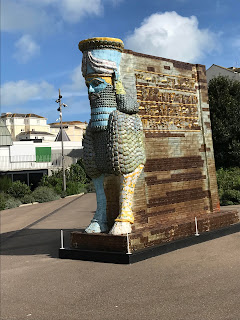
Image courtesy Rob Harris
(link below)


Michael Rakowitz, the sculptor, is an Iraqi-American artist living and working in Chicago – he is known for his conceptual art shown in non-gallery contexts.


Back Leg of Lamassu sculpture

Rakowitz is known for his recycled projects … be they salvaged date syrup cans as here, or reconstructed artifacts looted from the Iraq Museum and excavation sites from diasporic ephemera, such as newspapers and grocery stores.


Close up of hoof and lower limb - showing
empty date syrup cans ... 


'Our statue' is made from 10,500 Iraqi date syrup cans sculpted around a metal frame – it is 4.3 metres (14 feet) in length.


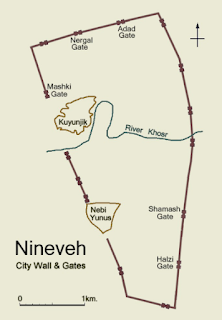
Lamassu, a winged bull protective Assyrian deity, that stood at the entrance to the Nergal Gate of Nineveh from ca. 700 BC until February 2015, when ISIS destroyed it along with artefacts in the nearby Mosul Museum.


Lamassu, Neo-Assyrian Empire 
(c 721 - 705 BC)


Here we find Rakowitz reminding us about the disasters we are inflicting on the world through human, economic and ecological disasters caused by the Iraqi Wars (in this instance) and their aftermath …


today we need to add at least two other wars in Ukraine and in Israeli/Gaza … let alone all other natural and unnatural disasters we are exposing the world and its occupants to …


As a reminder Iraqi dates were once considered the best in the world and formed the country's second largest export after oil.


Nineveh - city wall and gates
(NB Nergal Gate - top left)

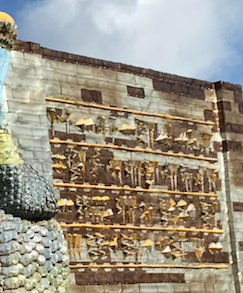
The sculpture is entitled 'The Invisible Enemy should not exist (Lamassu of Nineveh)' – the carved cuneiform inscription was invisible to travellers as it was embedded into the wall of the Nergal Gate …


here Rakowitz has it exposed … while it translates as “Sennercherib, king of the world, king of Assyria, had the wall of Nineveh built anew and raised as high as mountains”.


Lamma - protective winged deity,
Sumerian Isin-Larsa period
(2000 - 1800 BC)


There's rather more to Lamassu and its (her) history – to be found per the links below; also more about Michael Rakowitz.


Then of course one remembers the past twenty years of wars (War in Iraq from 2003 - 2011) and the further destruction that has been inflicted on world societies … be they human, economic and ecological – so much history to remember, to learn about …
Close up of the carved Cuneiform
inscription - sorry not easy to see


I know exceedingly little about life in the Middle East centuries ago to today … so these links can send you off down rabbit holes … and have and will send me down them again …


As our town welcomes the Turner Prize 2023 to the Towner Art Gallery – in celebration Eastbourne has come ALIVE with art, music, and performance events … these are spread across the town waiting to be explored and enjoyed.


Lamassu makes a huge statement – as well as a glorious gateway for all the Turner Prize entries hosted by the Towner Art Gallery – available until middle of April 2024.


The winner of the Prize is due to be announced next week on 5th December … I guess I will revert – but I have to get my head round the entries – contemporary art is different: a learning curve!


Towner Eastbourne link - including photo by Rob Harris - showing the cuneiform inscription ... 

Green Art Gallery - showing details re the Trafalgar Square plinth ... 

Chicago Museum exhibits - "Lost Treasures of Iraq" ... lovely photos here ... 

Wikipedia - Lamassu ... 

Wikipedia - Nineveh ... 

Hilary Melton-Butcher

Positive Letters Inspirational Stories