Showing posts with label Healer. Show all posts

Tuesday, 12 March 2013

Gong Bath anyone? ... Random Act of Kindness – match this one? ... My return to the fray ...


No – I didn’t need rescuing from the Gong Bath!  I have not done nearly as much as I intended to – on the other hand I’ve made a good start on a number of things – my flat is somewhat more organised and tidier than it’s been for ages ... so everything’s in place – and my head too!!

Resonance ...

Lenny’s comment touched me ..."for sure i’m gonna miss you my special friend.  Have a real fun time and come back and tell us all the cool stuff you did.”   


So, of course, I dropped Lenny an email ... saying I was here and we could email if he wanted to stay in touch that way .... oh yes, he did – and has kept me amused ever since ...!!!


The envelope with badge are at the back,
the card with a cat on it, Lenny's letter -
complete with Rocky headed notepaper +
Racoon footprints!, some chocolates, a
notebook, a bookmark ... 
I mentioned I go back up to the Nursing Centre to see one particular lady, Linda, as she doesn’t have any relatives ... is so lovely, doesn’t complain and gets on with her life as best she can, while my visits seem to cheer her up.


Back came ... "i been thinking bout that lady you go visit at the home and how you said shes got not one family person.  i could like to get her a nice card and send it to you so you could give it to her.  
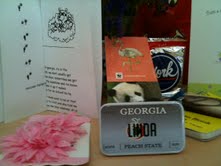
... and pink hair slides - aren't they lovely,
while the box of Georgia mints has Linda's
name printed on them ...
maybe it could make her happy to get it.  do you think its ok to send it even if she doesnt know who iam?  if its ok you could tell me her name so i could put it on the card.”


Linda was so pleased to receive a card and little packet from the States ... I’d warned her a surprise was coming – she was soooo delighted though and I know really warmed the cockles of her heart ... thank you Lenny!


Lenny wrote a letter to her too – two pages ... [so Roland (or Mark Twain) – Letter Writing isn’t dying here ...] telling Linda about his critter cafe, his family and life ... in his usual bouncy style ... just so lovely – and Linda was sooo soooo chuffed .... then I had to explain “chuffed” to Lenny!  He was very happy to know that she was so pleased.


Now to other things ... I went to various films – The Well Digger’s Daughter – a French film ... being one I highly recommend.


Ah -  the Gong Bath ... I go to the Natural Fitness Centre based in the old Lifeboat Station overlooking the sea ... in a gorgeous place to have treatments ... with a lovely group of therapists ...  (some of whom spent time with my mother - for which I was eternally grateful).

Sailing in front of the Natural Fitness Centre

I have done and do a mixture of Qigong, Meditation, Shiatsu, Pilates and have osteopathy treatments ... this time the Qigong group were offered the experience of a Gong Bath – we’re game for anything!!


We relaxed on yoga mats with the sound of the sea washing the pebbles in the background, then Gabby began her gong therapy ... ancient gong sounds resonated through the room – varying with the different sizes used ...

Gabby with some of her gongs

... the meeting of sound with form dissipates everything that is not real ... the frequencies bathed, soothed, washed through, immersed and seduced us ... taking us fully on our journey of whispering vibrations as we experienced the full effects of the harmonies over and in our bodies.


A promotional view - just looks
wonderful doesn't it
We each had different experiences ... I would love to have another gong bath ... to experience the harmonious waves that vessels of sound can bring us to a time of peace and healing in this chaos of human existence.


It was interesting and fascinating to say the least ... while being an area I’d like to explore further ... to find out more about the origins of therapeutic sound that were the origins of our vocal chords – yet which today still have powerful influences on our beings.


To change the subject yet again ... I’m over with Laura at Mistress Snark’s Parlour – having a zizz after tea with Jezebel ... one dangerous lady – still she’s lured me out of my lair and I’m blogging again!

I'm over with Jezebel discussing
feet measurements in barleycorn
sizes!


See you all soon – especially as the A – Z is rushing towards us ...


It looks like it’s a good thing I’m semi-snowbound today as I’m back blogging ... Sussex has had the worst of the snowy weather – not a lot, but enough to ice up, block roads ... the wind was terrible yesterday ... 


Sunset at the NFC
... and the Natural Fitness Centre rang and said don’t come down ... we’re not sure if we’re about to swim or stay dry: squally winds, a high tide and a full moon did not help ...  update to follow ...


Roland Yeoman's post about Letter Writing in the 21st century ... 


Hilary Melton-Butcher
Positive Letters Inspirational Stories

Tuesday, 25 September 2012

Kew at the British Museum: North American Landscape


Banner high – the Perennial Lupin with its bumblebee – invites all visitors to the British Museum to explore the North American landscape ... without leaving central London.
British Museum's banner


Silly me – goes in to the Museum and asks where’s the display – outside they say!!  So outside I go – and yes the ‘flower bed’ in front of the Museum has been planted up as a trail through the Florida swamps, the Missouri prairie to the forests of New England and Canada.


For the past five years the Royal Botanical Society, Kew have teamed up with the British Museum to create a landscape on the Museum’s West Lawn (I see that’s what it is called!) ....


.... bringing Kew into the heart of London – and by wandering through the landscape, visitors can discover more about the relationships between humans and plants – from Native North Americans and new world encounters to modern conservation projects.

British Museum as the backdrop to the North American
landscape on the west lawn
Each of the planting areas was labelled up, the plants marked, and the areas were given brief annotations ... while the landscapes have been themed to complement the public programmes at the British Museum and Kew.


So far the habitats of China, India, South Africa and Australia have been celebrated in these annual partnership programmes – combining demonstrations, talks, lectures and study sessions – supplemented with videos, a slideshow of the star plants and the general pleasure of finding a landscape vista on the Museum’s West Lawn.

Devonian Botanic Garden, Alberta, Canada
(Pinus flexillis, Eastern Rockies)

Perhaps next year I can go up and see the next landscape and follow it through the seasons – its early planting, to summer flowering, to the autumnal glow, before the plants fade into their winter dormancy.


I was at the Museum to see two other exhibitions ... but I think I need to go back to visit the North American Galleries to see some of the native peoples’ close relationship with the landscape and its vegetation, which contributed so much to early European understanding of botany and natural history.

Black Walnut
Kew’s Millennium Seed Bank (worldwide) is working in partnership with organisations in Canada and the USA via the Seeds of Success programme to address threats to habitats and support the re-establishment of plants and eco-systems at risk.


Paper Birch tree
Native seeds are collected and stored in seed banks in locations in North America, with duplicate collections held at Wakehurst Place – Kew’s country garden where the Millennium Seed Bank is housed.


Sweet Grass
The American organisations involved are: Bureau of Land Management; Lady Bird Johnson Wildflower Center; Chicago Botanic Garden; Zoological Society of San Diego; North Carolina Botanic Garden and New England Wildflower Society; while in Canada it is the Devonian Botanic Garden in Edmonton, Alberta.


The British Museum’s press release highlights:

·        Sweet grass (Hierchloe odorata) – that is used as incense because of its vanilla scent and is sacred to many of the indigenous peoples of North America, who believe smoke from burning dried sweet grass welcomes in good spirits.

Many of the grasses’ natural habitats of wet meadows, lake-shores, stream banks and low prairies have been lost ... so the plant is now endangered.

·        Orange coneflower (Rudbeckia fulgida) is a member of the daisy family and is a prairie wildflower that thrives in open woods, meadows and pastures.

This species was first described in England in 1789 by William Aiton (1731 – 1793), the first curator of Kew Gardens, in his catalogue of plants cultivated at Kew (Hortus Kewensis).  Loss of habitat means this species is now becoming endangered.

·        Paper Bark tree was used by Native Americans to collect the sugary sap from trees like the Silver Maple, or the beautiful souvenirs made by Native women from the bark for trading.

·        Other plantings include Lupins, Echinacea, Maples, Black Walnut, Tulip Tree and carnivorous pitcher plants.    


Orange Coneflower
With the diversity of peoples we have in London, and those visiting each year, these landscape projects give everyone an opportunity to remember how diverse our planet is, yet remind ourselves that natural vegetation is under threat and many plant species face extinction ...


... by spreading the word, much as Kew and other botanic organisations are attempting to maintain the status quo of our natural vegetation, we can remind ourselves and others of the importance of our natural habitat and learn to protect it.

Echinacea
Let’s join together and help raise awareness of the importance of each of the world’s eco-systems and their absolute necessity to this life of ours, especially those locally around us ...


... let’s start there – preserve and nurture a little of everything ... let’s celebrate our botanical gardens, our allotments, our weed patches, our gardeners who encourage wildlife to remain with us for the centuries ahead.


The British Museum site provided much of this information, with some additional information from the Kew site.  Obviously the inspiration came from my recent visit to the British Museum.

Press release from the British Museum on this exhibition
Detailed press release from the British Museum
Youtube video (1.21m) showing landscape being created earlier this year.

Photos courtesy the British Museum site - except the Canadian one that came from the Kew article above.

Hilary Melton-Butcher
Positive Letters Inspirational Stories

Saturday, 27 November 2010

England’s Leonardo .. our hanging Hooke?

Skulduggery or Restoration – which one will out? This irascible, somewhat deformed man, whose incredible mind had led him as a child from the Isle of Wight to London, to the scientific community and through sheer hard work and brilliance had shone through and been accepted as assistant to a number of leading scientists, before becoming the Curator of Experiments to this coterie.

The age of global exploration had occurred, now – the 17th century - was the turn for learned minds to record new things and experiment with all things ... yet political and royal intrigue would influence the rise and fall of men.


Leonardo da Vinci (1452 – 1519): self-portrait in red chalk c 1512 - 1515
Unrest was stirring, Royalty was loved or hated, the Parliamentarians were on the rise ... clans and families were divided in these uncertain times. Oliver Cromwell rose to the fore as Protector of England (1651 – 1658), Charles I was beheaded at the climax of the English Civil War 1649, before Charles II, after exile on the Continent, was restored to the throne in 1660.

These were the times into which Robert Hooke (1635 – 1703)was born. He was the weak youngest child, of the local Royalist curate and schoolteacher, who showed prodigious interest in observation, mechanical works, and drawing (making his own materials from coal, chalk and ruddle (iron ore)) ... writing journals, illustrating them and keeping records: showing an early scientific mind.

He was sent to London, aged 13, to take up an apprenticeship, purchased out of a legacy from his father on his death in 1648, with Peter Lely, a Dutch portrait painter to the English Crown, before being accorded recognition, as a child with an energetic mind, by the scholarly headmaster of Westminster School, Dr Busby, who accepted him into his group of students.

Young Hooke quickly mastered Latin and Greek, made some study of Hebrew, and mastered Euclid’s Elements, while continuing his study of mechanics. The Elements is a mathematical and geometric treatise consisting of 13 books written by Euclid, a Greek mathematician, in Alexandria circa 300 BC. It has proven instrumental in the development of logic and modern science.

Busby had other illustrious pupils, including Christopher Wren, Robert South and John Dryden. In 1653, Hooke obtained a chorister’s place Christ Church, Oxford after taking twenty lessons on the organ! He was employed as a ‘chemical assistant’ to the natural philosopher Robert Boyle, who was constructing, operating and demonstrating his ‘new fangled’ air pump.

The Invisible College was the precursor to The Royal Society, consisting of natural philosophers (scientists) including Boyle, Hooke and Wren. (1646/7)

Hooke’s time at Oxford cemented his life-long passion for science, while his tutors and the friends he made were of paramount importance to him throughout his career. This was a time, the 1650s, when the Royalists were acutely conscious of the turmoil and uncertainty of the times: there was a sense of urgency in preserving the scientific work they perceived as being threatened by the Protectorate. This scientific group went on to form the nucleus of ‘The Royal Society of London for the Improvement of Natural Knowledge’, or as we know it today The Royal Society.

When Charles II returned to the throne in 1660 – he became a patron of the arts and sciences, founded The Royal Observatory, and supported The Royal Society, whose early members included Robert Hooke, Robert Boyle, and Sir Isaac Newton.

Charles II was the personal patron of Sir Christopher Wren, the architect who is credited with the rebuilding of London after the Great Fire of 1666, and the Royal Hospital Chelsea (Chelsea Flower Show location), which Charles founded as a home for retired soldiers in 1682.


The silk on a spider's web forming multiple elastic catenaries: The application of the catenary to the construction of arches is due to Robert Hooke, who discovered it in the context of the rebuilding of St Paul's Cathedral.
Hooke, whose great friend Sir Christopher Wren always supported him, was appointed Curator of Experiments to the Royal Society in 1662 and his agile mind originated much, postulating scientific achievements, recording each and every experiment for the Royal Society.

He was a genius amongst men – he was an Architect, Surveyor, Engineer, Chemist, Horologist, Physicist, Astronomer, Painter ... if his darting mind had time to complete his thoughts, and if he was not recorder for the Royal Society, we would not be so enriched today – nor would we have his story to tell.


Remains of the Cathedral after the Great Fire of London (1666) drawn by Thomas Wyck, c. 1673
The play, the play ... I am reminded I need to tell you the story and reason for the script (see my previous post: Hanging Hooke) ... as extraordinary as the man himself. The play opens with the booming voice of the auctioneer – One Million Pounds ... going, going ..... "Ah! Ladies and Gentlemen, there has been a development, Lot 189 ...... "

Why? Lot 189 was Hooke’s long lost Folio, found in the back of an old cupboard that had been casually handed to the auctioneers’ appraiser as he was leaving a Hampshire country house! Three hundred years later the evidence as to Hooke’s potential as a scientific genius was to hand.

The excitement at the find of the dusty Folio has been palpable – the Royal Society keen to preserve the papers under their auspices and the thought of that knowledge being lost again to some private museum was too much to think about.


Godfrey Kneller’s 1689 portrait of Isaac Newton(age 46)("Newton the unscrupulous" - perhaps? - he loathed Hooke)

Going, going and not gone ... the auctioneer’s voice boomed out ... “Lot 189 has been withdrawn”. Expectant gasps within the hall heard that after negotiation Hooke’s folio was going to back to the Royal Society where it belonged and from where it could be studied - the three hundred year old puzzle would finally be pieced together.

His time had come – Robert Hooke could take his place in the annals of English history at The Royal Society as only we can do in 2010 making his papers available for us all to peruse – via the wonderful technical device of ‘turning pages’.

What exactly happened to Hooke’s papers, his drawings and any portraits that would have surely been painted at that time before his vilification we shall never know; however Sir Isaac Newton’s abhorrence of Hooke is well known and when The Royal Society looked for new premises in 1710 after Hooke’s death ... is it possible that all semblance of records were destroyed then ... ?

The Royal Society in the 20th and 21st centuries however had other ideas and in their reconstruction of the Minutes of the Experiments and Meetings of that time – left stubs ... so that if the papers should ever come to light, they could be restored to their rightful place: forward thinking!


Sir Christopher Wren (aged 68) in Godfrey Kneller's 1711 portrait; (Wren was always a good friend to Hooke)
So Hooke hung for a while ... now he is being rewound and reconstructed... his papers have been found, his first burial place is known – but his remains and others were removed and reburied; two sites have been identified and if his remains can be found then the forensic anthropologists may be able to conduct facial and skeletal reconstruction – as they did for the Sir John at Stirling Castle.

So Hooke will once again be hung in pride of place amongst The Royal Society’s eminent Fellows, his papers restored to their rightful place, appropriate commemorative plaques have been installed in Westminster Abbey, at St Paul’s Cathedral and at the Monument will all remind us of our ‘English Leonardo’ – the man who for twenty years was one of our fathers' of modern science.

Finally rest in peace Robert Hooke – your time has come ... your story is being told (even if we have to decipher your coded papers!), which will be held within the annals of history forever.
As no contemporary portrait of Robert Hooke seems to have survived from the seventeenth century, this one is a reconstruction from the descriptions by his colleagues Aubrey and Waller. It shows him with a spring, pocket watch, fossil and map of the City of London after the Great Fire of 1666.

He helped to survey and plan the rebuilding. The sky on the left indicates his interest in astronomy. The original is an oil painting on board by Rita Greer, history painter, 2004. This was digitized by Rita and sent via email to the Department of Engineering Science, Oxford University, where it was subsequently uploaded to Wikimedia.
Picture extracted via Wikipedia - Robert Hooke


Further References:
The Royal Society - Hooke Folio
Bonham's (Auctioneers) Press Release - with picture of folio & Hooke's writing
Oxford University - Department of Science ... List of Hooke's achievements
Hanging Hooke: the play - Take the Space - Theatre Group

Dear Mr Postman – it’s been a quiet time .. my mother does come too and has enjoyed Susie’s company and Reiki practise; Sussex is now getting the white stuff! flurries of gentle flakes are falling ... Britain doesn’t like snow much! Snow in November is rare .. my mother said she was warm and cozy – I just want to jump in too!!
Hilary Melton-Butcher
Positive Letters Inspirational Stories

Thursday, 18 November 2010

Hanging Hooke ....

What are they hanging, who are they hanging, why .. and when? Good questions you might ask! This is a three hundred and fifty year old mystery, where tantalising pieces of information have been found within the annals of history, and where suddenly another surprise comes to light ... if you like dusty folios of the unexpected?

This is a post of two halves .. the first a play, also in two halves, then the background to the whys, whens and wherefores ... it is a murder .. but of a person’s reputation .. not of a man; it is a research of today for that man’s rightful place in society, correcting the historical records.


Hanging Hooke - A new play by Siobhán Nicholas: “Christopher Wren loved him; Isaac Newton loathed him”.
A reworked detail from a painting of Lucas Cranach [ Adam and Eve]; Siobhan advises that she asked Ken, their graphics designer of Good Dog Design, to find them a tree from the Garden of Eden: the apple referring to knowledge, curiosity and the Newton story.

The play opens in 2006 with the countdown of the auctioneer’s gavel ... knock on wood ... on wood ... on wood ... the booming voice announcing “Sale of Lot 189 at the reserve price of £1,000,000”, an air of expectation, the auction room chatter ceasing, everyone looks around ... who are the likely bidders ... will this important Folio be lost to the nation?

We, the audience in 2010, also wait in eager anticipation to see a new play, written by Siobhan Nicholas, put on by an innovative theatre group “Take the Space”, inspired to find out more about Robert Hooke (1635 - 1703), this man they call “The English Leonardo”.


An auctioneer's gavel

The stage is set ... the central square displays Hooke’s writing – taken from his Folio – a few props .. easels with pictures, some stacked up, a microscope, a telescope, tables with ‘treasures’, a small travelling chest... depicting the sparse times of the 1600s.

A play of two halves – where the youthful Hooke’s guardian gives us the background on his childhood, his illness and the political upheaval of the times; young Hooke’s total engrossment in learning about all facets of life from an early age ... his schooling, while having the freedom to roam his island (the Isle of Wight)– the whole of nature .. the sky, the sea and shore, valleys, fields and meadows with all its flora and fauna.

We are introduced to his early ‘play’, experimentation and research – where he spent hours looking at rock pools .. both for their beauty, the invertebrates, crustaceans, pebbles and rock formations, the refraction of the water, the tidal movements ... and then he recorded and drew all he saw. He experimented with clock-making, woodwork, and all things mechanical too .. searching to find more about the heavens above and the earth below.


Tidal Pool

This young fertile mind was ready for more .. so on the death of his father, he used his inheritance, at age 13, to buy an apprenticeship in London – the centre of learning. Here the actor changes from the ‘guardian’ to the misshapen Hooke – reminding us of his ‘broken’ body ... reminding me of the hunch-back of Notre Dame ... not so hunchback, but hobbling and lopsided: disfigured.

Chris Barnes, as Hooke, puts on a convincing performance, as he goes about his days as curator of this eminent group of scientists. We now begin to see his irascibility appear – this genius, who could apply himself to so many disciplines and experiments, as well as record his research within the auspices of the fledgling Royal Society.


Chris Barnes: performer for Hanging Hooke

The brilliant scientists were often overwrought keeping up with Hooke, justifying their results against Hooke’s brilliant mind, which would come at the problem from a different perspective. These men included Sir Christopher Wren, Sir Isaac Newton, Robert Boyle .. to a man: polymaths, scientists various, philosophers diverse ... a challenging time for all.

Hooke wondered aloud who his friends were – were they true – in those times of switching allegiances, or the powerful and rich demanding sworn loyalty .. men having no choice but to conform.

We see Hooke’s friends waiver under these demands, but such were the signs of the times – disagree with the mighty and they would be thrown into society’s wilderness of sleaze and poverty, their access to funding, to equipment, to like minds would be removed at an instant.

The auctioneer’s gavel beating down at the start of the play ... the countdown to the auction of the Hooke Folio ... the announcement that Lot 189 was for sale for £1,000,000 ... reminds us that three hundred years after his death we know very little about Robert Hooke and his works, other than a few references and deductive thought that there must have been more to this man.

The Royal Society records show that Hooke played a full part as Curator of Experiments and early on as the Secretary, keeping the Minutes of all experiments held and recorded: not as we would do today in a separate Corporate Secretarial Meeting held round a Board table.


Hooke's Microscope

He was appointed ‘Curator by Office’ for life, where his role was to demonstrate experiments from his own methods or at the suggestion of members. Amongst his earliest demonstrations were discussions of the nature of air, the noting of the difference between venous and arterial blood; experiments on the subject of gravity, the measuring of barometric pressure and many more.

Instruments were devised to measure a second of arc in the movement of the sun or other stars, to measure the strength of gunpowder, and in particular an engine to cut teeth for watches, much finer than could be managed by hand, an invention which was, by Hooke’s death, in constant use.

In 1663 and 1664, Hooke produced his microscopical observations, subsequently collated in the published work Micrographia in 1665, which Samuel Pepys (yes, the Diarist), announced that Micrographia “is the most ingenious book that he had ever read in his life” – some endorsement.


Title page of Micrographia

We know of Hooke through Hooke’s Law - the law of elasticity; we know he worked at the Royal Society – but there was little else, some references, the beginnings of an autobiography – but who was this invisible man? What happened, why was he no longer represented historically, where are the portraits .... Going, going NOT GONE ... but where did the Folio come from and what happened to it? AND more importantly what will we find out about our Hanging Hooke? I leave you gently swaying for part two ......

Dear Mr Postman – do you think I’ve been too unkind to my readers? My mother will laugh when I explain what I’m doing .. she would appreciate the joke. She had a treat this week and she was awake fortunately .. her daughter (me!) dressed in Medieval costume, pretending to play the Mandolin?! – fortunately our replacement therapist, Susie, while Janice travels to Brazil, Australia and California .. lucky for some! – can play and gave Mum a short recital .. I hope we have more .. and I shall feature them on here.
Hilary Melton-Butcher
Positive Letters Inspirational Stories

Take That Space - home
Take That Space - Theatre Group - people
Take That Space - Theatre Group - plays
Robert Hooke - Wikipedia - please contribute to Wikipedia .. small amounts much appreciated!
Wikipedia for many other links and useful information.

Monday, 26 October 2009

Sands of Time ...

Would you buy a golden sandy beach, without any rights other than ownership, except perhaps to raise income by authorising donkey rides, or sell ice-cream from a van? Thirty hectares of English property, consisting of 71 acres of sands and 5 acres of dunes, has recently been sold for £80,000.

This beautiful area of beach is where, as children ,we used to picnic and play in the sand-dunes, the rock-pools, jumping across the rocks at low tide, splashing as kids will in the surf (surfing was not an option then). Those days of freedom with the amazing views across to St Ives, and the other beaches we used to frequent dependent on the weather and winds; or we would drive south across the Peninsula to more sheltered coves in the vicinity of Penzance.

Godrevy Lighthouse has become synonymous with Virginia Woolf’s book “To the Lighthouse”; as it is believed, that although the novel is set in the Hebrides in Scotland, the lighthouse described is based on Godrevy, seen from across the bay when she was holidaying in St Ives as a child, or latterly with other members and artists of the Bloomsbury Group.

The colours would have been more amazing at Upton Towans, the beach sold, in the early part of the 20th century, before the cleanup of the mines started to take place. The little Red River runs out here, and when we used to visit there were still shells on the beach and in the water, the sea ran red, with the shells having taken on some of the colour (rather like the autumn leaves I described in the previous post).

Someone with Cornish connections is the purchaser, who is obviously philanthropic as the beach must remain open to the public, so those literary pilgrims may wander imbibing Woolf’s depictions, together with beach lovers there for the surf, that special light of the bay and the magical atmosphere that comes with being by the sea.

The shifting sands of time – the area was settled in medieval times, then tin mining and copper mining were possible in the early industrial days, before the revolution and its new developments took over, leaving numerous tiny backwaters of life around the country – however the sand dunes (known as ‘towans’) claimed a once prominent village – now buried and lost until the dunes move on and release their secret treasures.

Time moves on and as we learn more and more – we are able to find hidden ancient treasures beneath the rising seas (estimated 7.5” (190mm) per 100 years), to bring new knowledge of our world 2,000, 10,000 or more years ago .. so the creeping sands release their artefacts, the cliffs crumble spilling their fossil skeletal and shell remains out for us to find.

Will Gwithian beach be here in 1,000 years .. as Canterbury Cathedral withstands that test of time. The limestone used in its creation was brought over from Caen in northern France by the Norman craftsmen, who understood their stone and the need for longevity. The sedimentation process occurred millennia ago, compacting down to form various types of stone used by man as building materials, once they acquired the tools to work this earth.

Sand from Pismo Beach, California. Components are primarily quartz, chert, igneous rock and shell fragments. Scale bar is 1.0 mm.

The Norman craftsmen were renowned for their magnificent Abbey and Monastic buildings, so when the Saxon cathedral at Canterbury burnt down in 1070, William the Conqueror, as King of England, put their skills to good use to rebuild the Cathedral as a testament to one of the great holy places in Christendom, as well as cementing this first place of pilgrimage for those arriving in England from the continent.

The Caen stone, these craftsmen had used and loved for its ease of working, which over time hardens with its exposure to the air. The grain is fine, it is what is called ‘a live stone’, which means it can be sawn, or squared up in any direction – the crystal structure does not restrict the directions in which it can be worked: making it ideal for the intricate stone carvings that surround the structural elements.

Canterbury Cathedral from the city entrance

The missionary Augustine was sent over to England in 597 AD from Rome to found a place of worship, which is now encompassed beneath the current nave, but which would become the stunning Norman Cathedral that stands today, exuding wealth and splendour to all who have visited over the past one thousand years.

Repairs in the 20th century have been urgently required due to the erosion caused by the atmosphere and acid rains; much has been learnt however by the stonemasons of recent times. Relatively cheap stone was used, until it was realised that it stained too easily, and it did not weather well, as repairs made in the earlier years of the 20th century are now already shown to be disintegrating.


Église Saint-Pierre, Caen. The restoration of the 'chevet' shows the real colour of the stone.

So once again a similar limestone is being imported in massive blocks, weighing about two tons, to be worked on in the stonemasons’ yards before being assembled within the Cathedral structure to stand against the elements for another millennium.

This land of ours offers so much that perhaps we do not realise, the common sedimentary rock, cut and worked, still standing proud above the earth, once man realised its benefits, while nature’s sea sands erode and mould our coastline, laying down new layers for future generations to find.

Dear Mr Postman – I see your strike goes on .. but I’m pleased you’re able to deliver my letters; my mother has been asleep a lot recently, chatty and cheerful with the staff – as she says a laugh makes everyone happy – but then very sleepy when I’ve been around.

Perhaps the effects of my uncle’s death have yet to seep through, though Janice, our healing touch therapist – who is more!) talks to Mum about Derek, as do I when the occasion arises, and I asked the vicar to spend a little extra time with us immediately after Derek’s death – these things all help I think.

However apart from remarking on my cold hands – unusual for me – ‘don’t put them near me’!, she’s always asking about the blog! We have yet to ‘do’ all her birthday letters and cards properly – but she will have another period of wakefulness soon I expect.

Hilary Melton-Butcher
Positive Letters Inspirational Stories

Monday, 11 May 2009

Mum and Day at hospital ...

Dear all .. Mum got sent back down to the hospital .. but all seems to be well and so spent 12 hours there .. and she'll stay overnight and then go back to the Nursing Centre probably tomorrow ..

I'm coming over to San Diego day after tomorrow .. so my posting will be fitted in as and when .. as today has disappeared .. and most of tomorrow will too I suspect ..

I'm here .. just not very posting oriented ...

Thank you - blessings to all ...
Hilary Melton-Butcher
Positive Letters

Wednesday, 6 May 2009

Selfridges, Real Entrepreneurs ... Yellow - no I don't think so ...


Dear Mr Postman .. thanks so much for letting us have our letter .. my mother will be delighted to have her story .. today is a good day .. Janice, her healer, who has become a 2nd daughter to my Ma is able to visit this afternoon, and it's been agreed that the operation will go ahead tomorrow = thank goodness - it will be wonderful to get my Ma out of the hurly burly of hospital. This story amused me and I'm certain it will my Ma ..


It is reprinted in The Week and was a letter, entitled Managers' Pay, written by Carl Mortished to The Times: "Once upon a time, a managing director was just a superior manager. Today they are rewarded like venture capitalists, risk-takers who claim a big return for taking a personal financial risk. This is absurd because Sir Fred Goodwin and other Chief Executive Officers have no skin in the game: they are staff. An entrepreneur is someone who might mortgage his house, his spouse and his own sanity in pursuit of some mad scheme to make a better umbrella. An entrepreneur does not yearn for the key to the executive loo."


I just liked this story .. my mother was an entrepreneur .. she bought a hotel, converted it into a Care Home, got bored with that .. knocked some of it down and built a wing one end, and a flat and extra rooms the other - doubling its size .. and owned it for 20 years before selling it a few years ago. 

Just so you know the extra wing .. had to be shored up into the granite cliffs of Newlyn, Penzance with enormous bolts and I mean enormous!! It was a labour of love for her and her patients .. she loved them and nursed them to the end - that's what makes these weeks so incredibly unfair on her ...


Another icon of London's West End celebrates 100 years of existence .. Selfridges .. the Yellow shop .. they've chosen the most wonderful rich deep colour yellow - pantone -109 yellow .. as their brand colour - and this May are offering some limited edition items .. I'm rather taken with the watch by Toywatch! Though there is a Fender guitar, a Marc Jacobs handbag .. etc.


Harry Gordon Selfridge went to work for his cousin's store in Chicago, at less pay than elsewhere - but encouraged by his mother, he took the job. 

He found his passion for retailing and with his imagination he gained promotion becoming retail manager in 1887. His holiday time was spent studying other luxurious stores and bringing their innovations in the Chicago store.


Selfridge had his first trip abroad in 1888 and wanted to take his cousin's business into the international arena .. Marshall Field, his cousin, wasn't that keen and decided the easiest way to retain Harry's interest in the Chicago store was to give him a large salary increase, and loan him $250,000 to become a junior partner. He carried on for 13 years .. opened a rival store in Chicago .. but wasn't happy and set off at age 50 to explore pastures new.


London became his stop off point .. while a Jewish banking friend suggested the 'dead end' of Oxford Street .. it is the Marble Arch, Hyde Park end of Oxford Street. 

It was at this stage that the Selfridges monogram was devised: the sign being a combination of the pound and dollar signs. So he had his store, he had his logo, he had his passion - his retailing and his international knowledge .. and the rest is history ... 

... he did however try for one other icon - which would have made his day: that the underground would stop at the shop and the station would be called Selfridges! Marble Arch and Bond Street as names and places won that battle.


Bathing machine and "sea costumes" c 1910

I've just spotted an advertisement that would amuse my mother too .. one of their first ads is entitled "Some Charming Sea Dresses" .. I can't find the image .. which is frustrating me, but have inserted another ... but that's that ... just imagine putting on a dress to go swimming - how times have changed!


Just a note on the colour yellow ..the word yellow comes from the Old English geolwe which derived from Old Germanic. The oldest known use of this word in English is in the poem Beowulf, in a description of a shield made of wood from a yew tree. 

Yellow has traditionally been associated with jaundice and cowardice. Yellow usually refers to "caution" and is the second light on traffic lights or stop lights; in American slang, a coward can be said to be "yellow-bellied" or "yellow". 

The colour is associated with ageing as well, for both people and objects (e.g. "yellowed" paper). "Yellow" ("giallo"), in Italy, refers to crime stories, both fictional and real. 

This began in about 1930, when the first series of crime novels published in Italy had yellow covers. I love Selfridges' yellow .. however entrepreneurs are not yellow!


Thank you Mr Postman for dropping by .. it will lighten my mother's heart .. I can at least show her the picture of the "Charming Sea Dresses" and she will laugh .. and we can remember the times of her start up with the Care Home - Mr Mortished's letter does seem to put things into perspective doesn't it?

Pantone Yellow Guitar and ToyWatch are courtesy of: http://limitedhype.com/2009/04/selfridges-x-converse-centenary-edition-yellow-pantone-109/
Selfridges 1909 picture is from the Bedford Lemere collection, held as an Archive reproduced by permission of English Heritage.NMRReference Number: BL 20507

Hilary Melton-Butcher
Positive Letters Inspirational Stories