Showing posts with label Herbs Spices and Herbalists. Show all posts

Wednesday, 15 March 2017

Herbs, Spices and Herbalists – Mint: Part 7 …


Tis coming up to Easter … the time of roast lamb, new potatoes glistening with butter and mint, mint sauce, home-made gravy, baby leeks, and new carrots … a delicious Easter lunch welcoming in the early Spring …

Garden Mint


… garden mint is not that convenient … desperately easy to grow, but incredibly keen to spread – keep it in a pot … however an essential for lamb and/or new potatoes – Jersey Royals perhaps …


Mint Jelly - so so good!


… yet the Lamiaceae (or Labiatae) is a ‘huge’ family of flowering plants commonly known as mint or deadnettle … they include Mentha, the strongly scented herbs, and include Peppermint and Spearmint … as well as many other varieties: apple mint, orange mint, pineapple mint …


Winter Savoury
To my surprise the Mint Family also includes a large number of herbs, lots of small shrubs and a few medium to very large trees … including basil, rosemary, thyme, savoury, lavender, sage, marjoram and others … also the tropical hardwood tree ‘teak’, which I would never have put into the ‘Mint family’ …


Jersey Royals simmered in Mint, tossed in butter,
sprinkled with parsley

We will concentrate on our Garden Mint … which George Orwell proclaimed that new potatoes simmered with mint and tossed in butter were superior to the fried potato dishes traditional in other countries … he has a point …


Jersey - highlighted in the Channel
Islands


Keith from Keith’s Ramblings reminded me in my Boxty post that it can’t be long before the Jersey Royals are in the shops – heralding the start of Spring in a foodie way … the first outdoor produce from the warmer Channel Islands – that has led to this ‘Mint’ post …


Freshly made mint sauce

Pliny the Elder (AD 23 – August 25, AD 79) was keen on mint … ‘the smell of Mint doth stir up the minde, and the taste to a greedy desire of meat’, so it looks like mint sauce has been around for 2,000 years + and more I expect …


Mint is known to have originated in Asia and the Mediterranean region … the Greeks used it to clean their food tables, bathed with it … whilst the Romans used it in sauces, as an aid to digestion and as a mouth freshener.


Growing potatoes on Jersey
with Mont Orgueil castle in the back ground

Medieval monks developed further culinary and medicinal uses … as mint symbolised hospitality and was a welcome of friendship to guests.  The Jews strewed the floors of their synagogues with mint so that its clean and aromatic perfume scented the place as they entered to worship.


Shakespeare loved his plants and wove them into his tales … as here “The Winter’s Tale (Act 4, Scene 4):


"Hot lavender, mints savoury, marjoram,
The marigold, that goes to bed wi’ th’ sun
And with him rises weeping.  These are flowers
Of middle summer, and I think they are given
To men of middle age.”


Mint Chocolate Ice Cream


Mint goes with so many things … chopped mint and sugar on pineapple, or grapefruit slices – can I say chocolate – let’s move on … how about finely chopped mint with some sour cream, or cream cheese, served with a baked potato …


Mint leaves added to refreshing lemon water

… while at home as a deterrent for the ever present clothes-moth, or ants and the cabbage white caterpillar in the garden … then our bathrooms, our mouths … we would not be same without the tingle of our toothpaste cleansers …


Twinings Mint Tea


So here’s to Mint – enjoy a cup of mint tea, a cool glass of minted lemonade, or mint water … peppermint is a native to these shores … and is good for indigestion … I will not make an obvious link to Brexit …


Rack of Lamb with Mint Sauce

… but I am looking forward to British Spring Lamb, with new potatoes, mint sauce and freshly dug vegetables … simple foods that nature provides from the earth …


Melon Salad - so refreshing in summer
with the sprinkling of chopped mint


One final idea – a recipe I came upon as I was starting out in life which inspired my love of herby bread – that’s a standard when I cook – how about a melon salad … melon, cucumber, tomato pieces … with a vinaigrette of choice, fresh chopped parsley, chives and mint to sprinkle over … served with the herby bread – oh so good!!


Hilary Melton-Butcher
Positive Letters Inspirational Stories

Thursday, 26 January 2017

Herbs, Spices and Herbalists - Paprika: Part 6 ...


Patrick Leigh Fermor’s second book of his trilogy: 

“A Time of Gifts”, 
“Between the Woods and Water”, and 
“The Broken Road” 

Between the Woods and
Water - by Patrick
Leigh Fermor
... reminded me about Paprika … bringing back those memories of Hungarian goulashes often served or created in the 1960s …


… but the descriptive passages Fermor uses, as he traverses and stays in the Great Plain of Hungary, brought the rich haze of summer to mind:


Hungarian Peppers air drying


The summer solstice was past, peonies and lilac had both vanished, cuckoos had changed their tune and were making ready to fly.  Roast corn-cobs came and trout from the mountains; cherries, then strawberries, apricots and peaches, and, finally, wonderful melons and raspberries.  

The scarlet blaze of paprika …”


Szeged is just below the "Y" of Hungary;
Kalocsa (not shown) is about where the
"A" of Hungary appears.


Szeged and Kalocsa are two of the main towns in the southern part of the Great Plain ... while the Paprika Museum in Kalocsa records Capsicum’s history …


… I have to say I thought Paprika originally came from Hungary … but no – originating in south - middle America, it is thought the Spanish Conquistadores brought the plant over… capsicum acclimatised very quickly and was first used as a decorative plant.


The Carpathian Mountains surround
the Great Plain of Slovakia, Hungary, Romania
and Ukraine: the Danube and its main
tributaries run through it ... 


Similarly to my post on Marzipan – the trading routes played their part in its dispersal across Europe, along the Mediterranean, through Africa, Persia and north into the Great Plains of Hungary via the Danube River with the Turkish expansionists … which led us to those Great Plains which Fermor describes so evocatively. 


Capsicum a member of the Nightshade family … has many varieties in hues of gold, vivid greens, amber, vermillion or chili red … the early herbalists realised the medicinal values … a fine natural body purifier and internal disinfectant … while a variety of other remedies are being researched.


Peppers are hugely nutritious … they have more Vitamin C than an orange, and have relatively high amounts of Vitamins B6 and A.  These contain 94% water, but once dried they have different nutritional values.


Dried Paprika


Pungency varies – the Mexican - American types tend to be spicier: the chili cayenne types - while the Hungarian/Spanish Paprika is made from the milder, pointed-shape paprika fruit.


Hungarian sausages and hams

Hungarian and Spanish peppers are dried and ground, or used as vegetables or in salads … added to stews, sauces and now ubiquitously added to all manner of produce – particularly sausages (Spanish Chorizo … pork, sweet paprika and garlic, then cured).


Hungarian Veal Paprika with Nokedli
from Crumbs and Tales

Hungarian paprika veal … I’m sure I made this back then!  Delicious … fillets of veal, dipped in seasoned flour, lightly fried – remove meat and keep hot.  Mix paprika to taste with some soured cream and add to pan, stir in gently … and replace the meat.  Simmer gently and serve with new potatoes, nokedli (dumplings) or rice, green vegetables etc …


Hungarian Goulash
Szegedin Goulash

Hungarian goulash – where paprika is an essential ingredient – uses cubed beef, onions, tomatoes and small potatoes … brown meat and onion, add seasoning of paprika and garlic, salt, tomatoes … add in small potatoes and gently simmer … making a meal for friends and family, or a smaller pot … serve with sour cream ... 


Remember when using paprika that it has a high sugar content and burns easily …  so do not cook over a high heat for too long, and make sure there’s some liquid in your dish.


Bell Peppers with almonds, add in
some garlic, seasoning and whizz
with oil ... Romesco sauce


There are so many varieties of the capsicum plant that are necessary for particular sauces … eg Romesco Sauce - while for now I’ll leave the cayenne/chili cultivars for another post, together with the fabled Scoville scale.


Paprica Museum in Kalocsa: see here
for more information on the museum


The black pepper, some of us use so liberally, is not related to the capsicum … pepper nigrum is native to south India … and has a different botanical relationship to that of capsicum or to Sichuan pepper.  The generic name “pepper” probably comes from the Greek word kapto ‘to gulp’ … that makes sense?


To tempt you further ... a delicious range of wines,
fruits and dishes from Hungary
Hungarian Cuisine from Globe Centre Travel


This wonderfully useful ancestral spice has been used for generations … so encourage your family and friends to include some in their diet … though be aware, that some people may be allergic to them … but certainly for me I can see the benefits …


… and will continue to enjoy my peppers as a vegetable or in my salads … so many ways to use them …


Hilary Melton-Butcher
Positive Letters Inspirational Stories

Saturday, 10 December 2016

Cinnamon – homely and exotic …


… definitely a spice … I will, anon, add a Cinnamon post into my Herbs, Spices and Herbalists series – for now let’s celebrate its festive attributes …

Cinnamon with apple

 We are into that Christmassy spice … oh aroma! wafting from the homely domestic kitchen … the pervading spicy scent inhabiting all corners …


Share mulled wiine while making
Christmas cookies, pomander oranges


Christmas is a-coming … and what better way than with some cinnamon dishes to tempt you to try old favourites, or new ones …


Cinnamon Roll
… share the kitchen with one or two friends, relatives near and dear … try new recipes out … entice, laugh and remember days gone by, look happily to the future …


Cafe de Olla
(see the Piloncillo cone)
Cinnamon – use a stick to stir your coffee … giving it a delicate, elusive flavour … or the Mexican speciality … Café de Olla – flavoured with cinnamon and piloncillo (unrefined cane sugar, typically found in the shape of cones) …


Or how about Persian Rice with Cinnamon ...
this version has lentils instead of pistacchios


Southern Fried Chicken – one of the best known of all American dishes … uses flour mixed with cinnamon as coating before frying … I’m not sure it would go with our Christmas turkey …


Choose the best - it comes from
Ceylon and is not the 'rougher' Cassia


So let’s use our ‘pudding stick’ the old English name for cinnamon … like a wand to transform all manner of foodie delights …


Stir the pudding ... add the cinnamon
Then settle down with some mulled wine, cinnamon sticks included of course … thinking about the baked apples with cinnamon, the Christmas cake, mince pies … some exotic Mexican flavoured chocolate …


Cinnamon Apple Tart - make some to
share at a community event


What more could one want in the build up to the festive season … a few kind words for everyone, a smile, food bank donations, charitable thoughts and pennies, and a good laugh …


Early Medieval Wassailers


Good King Wenceslas visits this blog next … and then it’s relax, chaotic preparation, and down time til the New Year … see you all in a few days …


An Anglo-Saxon greeting … Wassail: Be Thou Hale …:

A wassail, A wassail, A wassail we begin,

With sugar plums and cinnamon, and other spices in;


Sugar Plums and Cinnamon cake

    With a wassail, a wassail, a jolly wassail,

    And may joy come to you and to our wassail


    With a wassail, a wassail, a jolly wassail,

    And may joy come to you and to our wassail.


Please Remember Others ... and our Environment ... 


Hilary Melton-Butcher
Positive Letters Inspirational Stories

Friday, 18 November 2016

Herbs, Spices and Herbalists - part 5: Parsley


Parsley – the world’s most popular herb … provides a large range of valuable nutrients (over 80!) … so some fresh parsley should be in our diet every day … it is packed with vitamins C and K …

Curly leafed Parsley


This workhorse of a herb … and can go in just about any dish … its mild, grassy flavour (fresh, green, woody notes) will bring out other main ingredients, yet enhance the dish and give it a little burst of colour…


Flat Leafed variety


…use flat leaf parsley for cooking, as it stands up better to heat and has more flavour … but curly parsley really is just as good – use the stalks – extra flavour in them.


My favourite … herby bread … lots of chopped parsley, some spring onion greens, a little garlic if liked (or lots!), cayenne sprinkle, lemon juice … butter – mix together …

Herby bread


… cut a baguette in slices (right through) … spread with the butter mix, sandwich together, wrap in foil … and bake – then open packet to crisp top … and serve … an easy addition to any meal, or party snack …


Parsley, a hardy biennial of the Carrot family, only came into Britain in the 16th century … it usually dies after the second season, but the seeds will have spread around and so the garden will retain new plants.


Root Parsley


There is also root parsley (the Hamburg Root Parsley) … this is common in central and eastern European cuisine …


It was greatly venerated by the Greeks and Romans … for a Greek athlete or Roman poet there was no greater distinction than to be awarded a chaplet of parsley.


Nicolas Culpeper
A chaplet is a garland or circlet … or a string of 55 beads – one third of the rosary number – for counting prayers …


Nicholas Culpeper (1616 – 1654), the botanist, herbalist, physician and astrologer, noted that parsley grew plentifully on Hampstead Heath, Hyde Park and Tothill Fields (Westminster Abbey area).


Potatoes with parsley and garlic


There were numerous ‘medicinal’ ideas for the use of parsley – but we will stick with its benefit of being rich in the vitamins C and K …


A bed of curly parsley set off
by some pansies
… at this time of year for colds, or for general good health … check out the various health benefits ascribed to these two vitamins … let alone parsley’s other benefits.


My parents grew beds of parsley for sale after the War … so I guess the Ministry of Ag   (agriculture!) … promoted it as nutritious for its war-ravaged population.


Tabbouleh - Lebanese salad

I have looked up parsley in a book (originally published in the 1800s) and thought you’d be interested in some other snippets:  apparently it is good for animals too, apart from flavour for the meat, it helps to cure foot-rot in sheep …


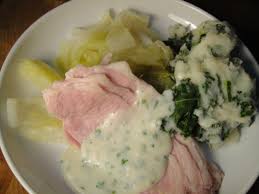
Ham with white, parsley sauce
… and when chewed it will take away offensive odours of the breath, such as when onions have been eaten, or spirits have been drunk.


Today … it is used in numerous dishes … parsley white sauce, Italian Gremolata (parsley, garlic and lemon zest mix), French Persillade (chopped garlic and parsley), Lebanese Tabbouleh and in many ways as a garnish … mixed in, sprinkled on top, or sprigs to decorate – which so often get munched by family … we do!


Fennel, Celery and parsley salad


Now it’s the dark days of autumn/ winter here … we all need parsley … so let’s remember to add it to our meals … or regularly eat a few stalks …


Fennel, Celery and Parlsey salad, or with salad mixes, including rocket, lamb’s leaves etc … then dress with vinaigrette of your choice, served with shavings of parmesan cheese – sounds delicious to me!


Enjoy protecting yourselves against the evils of winter draughts, bugs et al …


Just remembered this planter marker at Herstmonceux Castle ... not sure the Parsley looks so good - maybe she wants a divorce already?


Hilary Melton-Butcher
Positive Letters Inspirational Stories