Showing posts with label Middle East. Show all posts

Friday, 31 May 2019

We are the World Blogfest # 25: The Lemon Tree Trust ...


‘Growing Home’ … a way of giving life to a war-torn world … war gardeners brighten up the lives of those who have to live in imprisoned spaces …

 
c/o The Lemon Tree Trust site

… planting seeds to give colour, to let there be food, to have shelter in the dust of northern Iraq, or as the Royal Horticultural Society found in an internment camp a hundred years ago …


… the wheels of time go around, sadly nothing much changes, yet humans will always have hope and work towards improving themselves … wherever they are – even in ‘prison camps’.


"We had so many flowers in Syria.  This garden
makes me happy" ...

The Lemon Tree Trust, a not-for-profit organisation, active since 2014, supporting greening initiatives in forced migration camps … helps marginalised communities …


A haven for the children, who live or were born, in the camp


Urban agriculture, however limited, starts a process to create new and unrealised potential for those with nothing … 


One of the kits available for a household in
a refugee camp

... it gives them joy – a flower for its scent or delightful beauty, extra food – vegetables and fruits, dignity for the gardeners, hope for their families and others, and a sanctuary – a quiet personal space …


Ten gardens …
       Ten plus ‘war gardeners’ …
                Seeds were sown …
                        Greening started and was nourished …
                                Stories flowed, ideas spread …
                                        Insects and birds came …
        

A wondrous patch of land gave these hardworking gardeners some solace, where roots could be put down – even in their time of displacement … for many years ahead.

The video about the Liberation Garden is
on the Lemon Tree site


Domiz is a camp for Syrian refugees in Iraqi Kurdistan … which gives us an insight into the Trust’s work there … it is quite extraordinary and so wonderful to see …


A panorama of Ruhleben camp taken in 1917 by
Nico Jungmann, one of the detainees - who was
an Anglo-Dutch painter

…  man can be amazing, so generous, so adaptable, so accepting (in that there’s no choice) … the Trust gives them opportunities to personalise their lives within the patches of land available.


Please look at the videos on the Lemon Tree Trust’s site to see the wonderful little havens of love they have created for their families and community …


Archival photo inside Ruhleben's Horticultural
Society's Nursery


This Lemon Tree Trust link is to the Royal Horticultural Society’s video and information on the Ruhleben Internment Camp … where requests from the camp to the RHS mirror those being made today fromDomiz and other refugee camps …


This is the link to Wikipedia’s page on Refugee Camps – a long informative overview – with detail of the camps around the world.

We are the World  -  In Darkness, Be Light

The Lemon Tree Trust site includes a number of videos on the refugee gardeners, the gardens, about Domiz camp and more ... "Growing Home" video (10 minutes - well worth the watch)...


Please check out some of the videos and the gardens in Domiz - with some of the facts of life there ... it's informative and (sadly) interesting ... but heart-warming ... 


Lemon Tree - used by Tom Massey in
the RHS Chelsea's 2018 garden

Wiki page on Ruhleben Internment Camp - interesting to read the history on this camp in WW1 ... 


Tom Massey, the landscape and garden designer for The Lemon Tree Trust garden at the Royal Horticultural Society Garden, Chelse 2018 ... the details are here ...


Hilary Melton-Butcher
Positive Letters Inspirational Stories

Saturday, 12 March 2016

Knickerbocker Glories … and Rhubarb, Rhubarb, Rhubarb …


Knickerbocker Glories … what are they and where did they start … so many of you have asked or commented on Jenny’s Knickerbocker Glories … 


Jenny concentrating  on her caramel style
KGB - at The Starter Bar, Ilfracombe -
part 13 of our West Country Tour
I thought I’d better make sure your visit sends you away, after you’ve commented of course, salivating happily ….


Essentially it is a layered cream sundae that is served in a tall conical glass to be eaten with a distinctive long spoon … a speciality of 1920s Britain.


It can be made with ice-cream, meringue, cream … and flavoured appropriately … with jelly, fruit and fruit purees, or chocolate ice-cream topped with chocolate sauce, or nuts and topped with a honey sauce, or caramel sauce …


Chocolate or fruit

You name it – and a variety will be created specifically for you … especially today when we have so many flavours of ice-cream available.


A Sundae dish ... here a banana, icecream,
fruits and ... 


Their generic term seems to be Sundae … but certainly as kids we’d occasionally have a Knickerbocker Glory – to get the big chunky glass with the long spoon … or then the banana split-sundae glass …


Wiki link here


However this Wisconsin historical marker declares that the Ice Cream Sundae was invented here at Two Rivers … and who am I to disagree … but I’ll keep the Knickerbocker Glory here in little ol’ England …


Early season rhubarb ... so pink and pretty
- grown indoors in the dark!

The rhubarb season seemed to have come early this year … wonderful pink stems with light green leaves – they’re poisonous!  So only lightly cook the chopped stems with some dark sugar … serve with custard or cream …


Rhubarb is one of those very English plants – quite often found in gardens … and it provides stems for use all through the Spring, Summer and early autumn … a free food too …


A crown of rhubarb - growing outside

… then preserve it, or freeze it (once poached or cooked), ready for use in tarts, pies, pudding, crumbles (oh so delicious) – spice it up with mixed spice, or add some glacĂ© ginger … it can be made into wine, chutney, jam, jelly, marmalade … and so on …


Mrs Beeton confirms some of these ideas! … she features in Wiki today … and advises that it is one of the most useful of all garden plants … I wish someone had told Mr TCP (my uncle) – when I asked if he’d got a rhubarb crown … back came the answer … oh no! – I buried it under the compost heap – I can’t stand the stuff … presumably my aunt concurred!  I looked longingly at the compost heap every time I passed!


Rhubarb and custard tart
Rhubarb is one of those plants that perhaps is synomous with school dinners – we had it at home … so were well used to having it for pudding (as we called it) … rhubarb fool a delicious mix of rhubarb with custard …


I have a few cookbooks as many of you will know ... and so searched for an interesting recipe – the Persian cookbook had one … “Rhubarb Stew” …


The book I used ... there was no picture of
Khoresht-e Reevâs
According to Margaret Shaida the Zoroastrian religion of ancient Iran, the human race was born of the rhubarb plant … this I can see will cause a few problems and questions … so I’ll move on … to other notes she gives us …


…. From ancient times rhubarb has been considered good for cleansing the blood and purifying the system.  When it arrived in England its medicinal properties were also highly valued … but only the last 100 years or so has it been consumed for pleasure ... when it was welcomed as the first fruit of summer – even though technically it is a vegetable.


... no photo - so I give you Rhubarb Crumble
So here the Persian dish “Khoresht-e Reevâs" is a pretty dish, the pink and red rhubarb affording a lovely contrast to the dark-green herbs.  Traditionally it is served in Iran to aid digestion - it is reassuring to know it is good for you!


I love Persian recipes … where there’s a hint of fruit in a meat stew as here … the dish consists of boned leg of lamb, chopped up, chopped onions, fresh parsley, fresh mint, some rhubarb and seasoning, which are added near the end – so the fruit doesn’t disintegrate …


Another KBG ... 


So here’s to a very pretty pink vegetable usually used as a dessert … and the ubiquitous Knickerbocker Glory or Sundae – depending on the style of dish … KBGs can be pink, white and creamy, chocolatey, toffee, caramel coloured … so many flavours now.


One always needs Cornish Clotted Cream with any dessert,
even with Knickerbocker Glories - this is a postcard

Well I shall at some stage try the rhubarb stew … I like the piquancy of the tart flavour with a rich lamb stew … 


... or how about oatmeal- coated mackerel with rhubarb sticks ... see link below ... 


... but for now I shall leave you drooling, or revolted at the thought of rhubarb per Mr TCP …


A very early post ... when I wrote about asparagus and rhubarb

Hugh Fearnley-Whittingstall's new season rhubarb recipes ... per The Guardian


Hilary Melton-Butcher
Positive Letters Inspirational Stories

Monday, 21 December 2015

DĂ©jĂ  vu Blogfest, Emily Hobhouse and her Open Christmas Letter …


A letter “To the Women of Germany and Austria” was a public message for peace signed by 101 British women suffragists at the end of 1914 as the first Christmas of World War 1 approached.


Emily Hobhouse authored the Open Christmas Letter and circulated it for signatures.  For now I leave you to read more at the Wikipedia page on the Letter … and I will draft my post about Emily next year.


The paragraph titled “Message” is worth reading …


Emily Hobhouse
(1860 - 1926)


One hundred and one years ago life was not much different ... wars were going on ... the genders were not treated equally ... food was scarce ... peoples from all over the world helped (and hindered) each other, ideas were sewn to improve the world ... and so it goes.


DĂ©jĂ  vu blogfest – I am afraid I failed … but I had a look at my posts – and you are all so generous in your support, and your thoughtful comments … that I felt you'd all come by  and read with elegant sufficiency! ... 


A hedgehog igloo


… except perhaps the Hedgehog and Harvest Mouse post earlier this month … with now the added question when cometh winter? … and how will flora and fauna adapt to these warm conditions …


… today is the shortest day of the year - tomorrow the light increases (yeah) in the northern hemisphere … becoming apparent in the middle of January.

Winter Cyclamen

So for now a very happy Christmas to one and all … and as Emily and her fellow suffragists from the UK, America, Germany, Austria, South Africa, India, Switzerland, Netherlands, Belgium, France, and many more sympathisers wished … 


… “Is it not our mission to preserve life?”


… today with our knowledge broader, I would add … we need to cherish all life … from a humble bee, to an innocent insect, to  creeping, clambering plants, to the elephantidae …


… the only surviving family of the order Proboscidea … and back to the chongolo – the renowned African millipede …


And as a respected member of Hilary’s society – Hardwick sends his 'bestest' wishes to you all for a very Happy Christmas and hopes you will have lots of happiness at all times …


Remember others … smile lots … think of the planet as you go about your Christmassy days and each of the 365 to follow as 2016 approaches …


Happy Christmas and/or Happy Holidays ... 


Hilary Melton-Butcher
Positive Letters Inspirational Stories

Monday, 24 February 2014

Back to Africa, human migration and British evolution over one million years and more ...


Thankfully, I see, I did qualify the last of my four posts last year on the rise of this earth of ours, and the spread of its peoples ... that more would come to light.

Photo of Homo - 
see Wikipedia

When I went up to London the other day I had time to spare in Eastbourne before the train left, as I’d hedged my bets re the flooding etc making sure I’d arrive in town for my appointment.


I browsed the newsagents picking up the New Scientist which appeared to have a few interesting blog-type articles in it ...


... one of which relates to the isolation of the tribes of Africa, once their species had started to migrate north populating the rest of the world after inter-breeding with the Neanderthals they encountered in the Middle East and further north.
 
Mitochrondial DNA-chart showing large
migrations of human populations ...
NB it is a map of the world - for easier
viewing check out Wiki and the photo data

At the time of my earlier posts in 2013 I’m sure I briefly thought well what about those peoples left behind ... letting them just get on with it ... til modern humans eventually emigrated back into Africa: how brazenly ridiculous can I be?!


The article I spotted is titled ‘The Return to Africa that Time Forgot’ reminding me of my previous posts ... it had been established that our homo sapiens species migrated out of Africa 65,000 years ... but what else happened ...

 
my iphone photo - see better
picture in the actual New
Scientist article
... other migrations had occurred during those 65,000 years and that western Eurasian genes had entered the African populations sometime between 900 and 3,000 years ago, hinting at important human migrations in historic times, that barely registered in written records.


The article (link below) refers to the ancient stories that seem to offer anecdotal explanations for the genetic findings ... viz the Bible and the Koran ...


So we all have a genetic legacy of Neanderthal in us, to a lesser or greater degree, including the sub-Saharan tribes or peoples  ... confirming that early humanity did U turns too ... and returned to their African roots.


Now here’s my new dilemma ... my original posts only referred to us:  homo sapiens ... yet there are four (main) human species in the story of our British evolution ...  as I found out from my research and in Wikipedia:


homo antecessor (earliest known human species): discovered in Spain  and so named in 1997; lived approx 1.2 – 0.8 million years ago.


homo heidelbergensis (sometimes called homo rhodesiensis): found in Europe, Africa and China.  Discovered, so named in 1908; lived approx 0.6 – 0.35 million years ago.


homo neanderthalensis (Neanderthal man): found in Europe and Western Asia.  Discovered, so named in the mid 1800s; lived approx 0.35 – 0.03 million years ago.


homo sapiens (modern man): found worldwide. Discovered, so named in about 1758; living from about 200,000 years ago ... and still going strong, I think!

 
Map from Wiki showing Happisburgh
during the early Pleistocene age;
note the land bridge to Europe: still
connected 800,000 years ago
To add to the excitement of our British evolution, recently it was announced that human footprints had been found in Happisburgh, Norfolk ... dating back 800,000 years – our ancestors from the homo antecessor period.


Prior to this discovery, the oldest footprint in the UK was only 7,500 years old ... one of our homo sapiens ancestors.


To tie all this together The Natural History Museum has a new exhibition entitled “Britain: One Million Years of the Human Story”.


At the entrance to the exhibition we will be able to see casts of the four human species in our evolution.


As the notes to the exhibition highlight – catch a glimpse of the drama and treasure you will find in our evolutionary story.


On the Natural History Museum site – there are films showing: 

  • how the four homo casts were made ... 
  • how the team of scientists uncovered and recorded our 800,000 year old homo antecessor footprints ...

Eddie Izzard

... and as I described in those earlier posts, where Eddie Izzard was used as an example with his Neanderthal features, there are films showing the tracing of Neanderthal DNA in other celebrities, such as Bill Bailey, Clive Anderson and Alice Roberts.


I’m really looking forward to seeing this Exhibition and looking back at Britain long before the Romans, Saxons and Vikings arrived ...


Then just to add to the general mix ... The Vikings (Vikings: Life and Legend) are coming to the British Museum ... I gather they arrive on 6th March 2014!


Science in all its disciplines just amazes me about how much is accessible to be researched, to be recorded ... I love this learning ...the internet offers so many possibilities to us, while I'm lucky to live near enough to London for regular visits.


NewScientist article by Catherine Brahic

NaturalHistory Museum Site – promoting the exhibition: Britain, One Million Years of the Human Story ... check out the films here ...

Wikipedia Homo page


Hilary Melton-Butcher

Positive Letters Inspirational Stories

Tuesday, 31 December 2013

Prayer and Leaders ... Hippocratic Oath ... Cockayne Syndrome ... Mandela’s song ...


On reading through all of Mark Koopman’s 76 blogging friends who contributed a post to his 50 States Of Pray blogfest ... and going through your comments on my posting ... I thought as 2013 turns into 2014 another similar posting would not go astray ...

 
Header photo from Soweto Gospel Choir's home page

... and so I hail the New Year in with a concoction of thoughts, quotes, and odd references that recently touched me ... and leave you with a wonderful rendition by the South African township of Soweto’s Gospel Choir ... it will entrance you.


A few of you mentioned from my prayer that our butterfly effect will spread widely ... as others and leaders are doing right now and continue to do ... I mentioned Ghandi, Mother Teresa and Mandela ...
 
Butterflies across borders - the
Butterfly Effect
c/o www.o-pie.deviantart.com

... then spotted two from our generational era ... Angelina Jolie: humanitarian, role model ...  “The Angelina Effect” became a recognised, measurable phenomenon ... which related to her work as a campaigner against sexual violence in war zones ...


... she addressed G8 foreign ministers and the UN Security Council ... both bodies responded with funding and a legally binding resolution.


As a special envoy for the UN Refugee Agency, she also travelled to the Jordan-Syria border and demanded more international aid for the people fleeing Syria’s horrific civil war. 

 
Condoleeza Rice and Angelina Jolie
at the World Refugee Day in 2005
I expect many of you are aware of her preventative double mastectomy after genetic testing revealed she faced an 87% chance of developing breast cancer ... she chose to share her story ... probably saving many women’s lives ... by opening up the lines of information ...


Then there is the Malala Effect – Malala the young school girl cold-bloodedly shot in the head by the Taleban in Pakistan’s Swet Valley, near the Afghanistan border in October 2012 ... who had defied the Taleban’s edict that girls should not be educated.


Malala was brought to Birmingham, to be operated on and looked after ... she was discharged early in 2013.


She has to be the youngest and most influential teenager on the planet as a champion of educational rights for girls ...
 
Malala at Strasbourg to collect
the Sakharov Prize forFreedom of Thought
... and on her 16th birthday, 12 July 2013, she addressed the UN Youth Assembly in New York ... concluding with these words:


“The terrorists thought they would change my aims and stop my ambitions”, she said.  “But nothing changed in my life except this: weakness, fear and hopelessness died.  Strength, power and courage were born.”


I think the butterfly effect is with us ... with us, and with leaders, who will in their own way rise to ascend above the hatred ... exposing the atrocities and unfairness in the world ... encouraging more of us to be further aware of how fragile life is and do something about it ...


Malala greets her audience with ‘Namaste’ (a reverential salutation ... widely used throughout Asia and beyond) and concludes her meetings with this generous gesture.
 
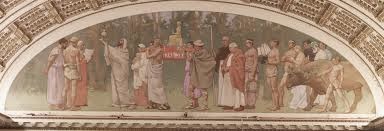
Mural of Peace by Gari Melchers, an American
artist, in 1896

While a number of you commented on ‘Ahimsa’ – mentioned by Theresa Milstein – its precept of ‘cause no injury’ includes one’s deeds, words, and thoughts ...


Then Jo, of Jo on Food, My Travels and a Scent of Chocolate, commented that ‘Ahimsa’ made her think of the medical oath “first do no harm” ...  which sent me off to Wikipedia and the Hippocratic Oath ...


... where the ‘definitive’ Wiki photo is of a 12th century Byzantine manuscript of the Oath, set out in the form of a cross ...  

12th century Byzantine
Hippocratic Oath

... which made me think of Robyn Alana’s (Life by Chocolate blog) comment .. that I’d managed to include a passage in Hebrew (which she could read) and the Byrd’s song based on a passage from Ecclesiastes ...


... and now this 12th C Byzantine Oath, originally written in Ionic Greek in the late 5th century BC, which requires a new physician to swear upon the healing gods that he will uphold a number of professional ethical standards.


The oath has been modified multiple times ... one of the most significant revisions was first drafted in 1948 by the World Medical Association, called the Declaration of Geneva ... in the 1960s it was changed to:

“utmost respect for human life from its beginning”

 ... making it a more secular concept ...

Humans are a global mix ... we really are much more alike with the same needs wherever we are in the world ... food, shelter, living without fear or worry, having love, compassion and caring people around us ...
 
Sandie posted this on her
blog: Chatty Crone
The Best Things in Life are Free

“Friendship isn’t a big thing ... it is a million little things”


An Arabic concept .... Patience, “the key to happiness”, is a virtue prized above others, and you will need to cultivate it in yourself if you’re to do business successfully.


Robyn Alana reminded us of the concept called “Tikkun Olam” ... meaning a healed world, which we pray for, but each of us is obligated to do our part to bring about peace of earth.


We are so lucky ... we should, as many of you ‘prayed for’ in Mark’s blog fest, give back, and pay it forward ... we have the internet – which has proved a boon to many ... friendships formed through blogging; information available to those searching for the name of an illness, as ...


Amy Garton Hughes, with her
mother, Jayne - from the BBC
Radio Today programme
... in an earlier blog post ..... I mentioned Scarlett (from Texas) and her son Knox, who has Cockayne Syndrome, whom I was able to meet in the autumn at the Amy’s Friends support group and annual ‘conference’  ...


... we have the radio, and on Boxing Day I heard a health item on Radio 4’s Todayprogramme on Amy highlighting how her mother through the internet found out about the cruel illness, Cockayne Syndrome ...


... then there is this beautiful spontaneous musical video tribute to Mandela in a grocery store ... three minutes of stunning voices ...

 
Taken from Woolworths home page
... just a wee bit of background information ... Woolworths (the general store) was American, came to Britain, Marks and Spencers opened their stores in Britain becoming clothing and food retailers, but in South Africa Marks and Spencers morphed into the name of Woolworths ... please do not ask – I have no idea!

But the video – will entrance you ...     Big Think: A Beautiful Spontaneous Musical Tribute to Mandela in a Grocery Store ... video and post found here ...


My references to Angelina Jolie and Malala came from the Sunday Times magazine, the world in pictures articles ...


Happy New Year to one and all ... may we remember others, may we be happy and positive, and may we improve ourselves ... health, wealth and understanding ...


... to everyone in this blogosphere, to the butterflies who will touch many of our extended bloggers, their families and friends ...


A very happy 2014

... and especially to all of you who have taken the time during the year to read my eclectic mix of posts and ideas – this probably really does seal the 2013 knot of them!     
Thank you!

Hilary Melton-Butcher

Positive Letters Inspirational Stories